The topic of the day: Can you practice law without a law degree?
This question intrigues the minds of many who wish to avoid the hefty expense of law school in the modern age. In the years 2024 and 2025, the idea of apprenticeships was viewed as a viable alternative for the bar.
“Yep, you can become a lawyer without going to law school at all. It’s perfectly legal in only a few states—and it’s called a legal apprenticeship or a law office study program.” – Miami Herald
In the past, the likes of Abraham Lincoln never attended any law school. Today, the option is available in the few jurisdictions that offer the “Law Office Study” route. While most people take three years in school, some take the route of an apprenticeship.
In this article, we will elaborate on the following:
- The state laws that allow legal apprenticeships.
- Historical cases that defined legal practice requirements.
- Alternative careers for those without a degree.
- The risks and rewards of reading the law.
Federal And State Regulations For Legal Practice
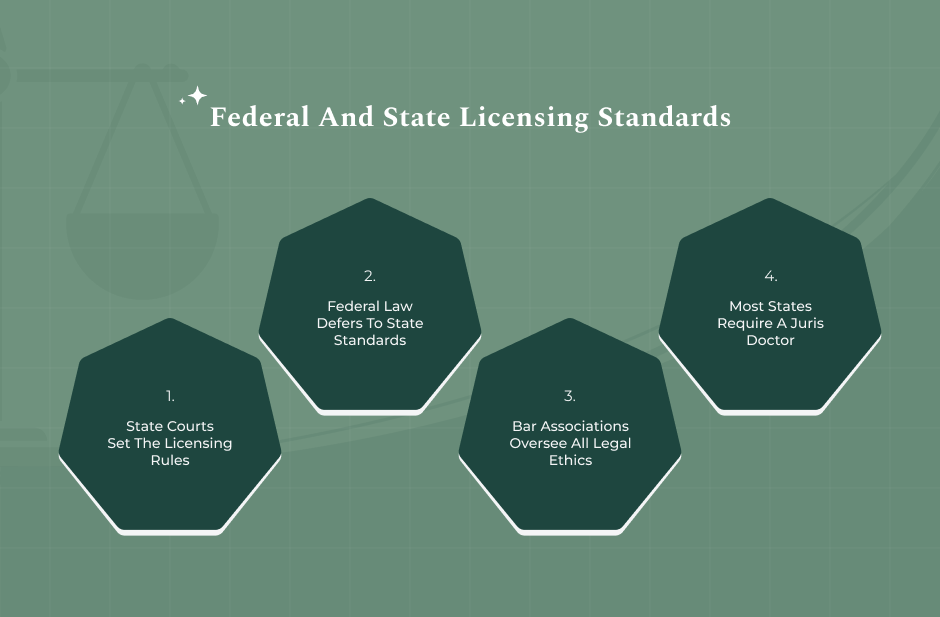
Can you practice law without a law degree? Federal laws do not dictate the requirements for those who wish to practice in the courtrooms of America.
Each state’s Supreme Court or bar association dictates their individualized requirements for obtaining a license to practice law.
The majority of states require an individual to graduate from an ABA-approved school before they can take the bar. Some states still place a higher value on the hands-on approach to learning.
The Constitutional Right To Represent Yourself
Can you practice law without a law degree? The Sixth Amendment grants you the right to a lawyer in criminal cases in the USA. However, it does not specifically state that your lawyer needs a law degree to help you.
This is where most people get confused and try to hire unlicensed lawyers to help them, but this is not right.
Pro Se Representation In Federal Courts
One way you can practice law without a law degree for your own cases is by representing yourself in federal courts, a practice referred to as “pro se.”
However, you are not allowed to represent others without a license from the state bar, as this is a crime in all states.
Rules For Self Representation
Can you practice law without a law degree? When you decide to represent yourself, you have to comply with all the rules of the court.
The judge will not favor you because you are pro se. You have to make your motions, as well as your evidence, in the right way. This is something that most people find to be much harder than they thought it would be.
Limitations On Pro Se Actions
You cannot represent a corporation in court, pro se. Businesses are separate legal entities, which means they have to be represented by an attorney. When you try to speak for a corporation, the judge will stop you right on the spot.
What States Can You Practice Law Without A Degree
If you want to know which states you can practice law without a law degree, there are some rules to follow.
Only a few states permit the old-fashioned route of becoming a lawyer. This is called “reading the law” and requires someone who is willing to mentor you. This is a long process that will challenge your determination and your legal ability.
States allowing legal apprenticeship paths are:
- California allows law office study programs.
- Virginia permits apprenticeships under a mentor.
- Vermont requires four years of study.
- Washington state offers a clerkship program.
The California Law Office Study Program
California is the most famous state where you can practice law without a law degree by an apprenticeship that lasts for four years.
You have to work in a law firm for eighteen hours a week with a supervisor. You have to pass exams regularly with constant feedback from your supervisor.
Passing The Baby Bar Exam
An apprentice in California is required to pass the First-Year Law Students’ Examination, also known as the “Baby Bar Exam.”
This is to ensure that the student is actually learning the law. If they do not pass, then they cannot proceed with their apprenticeship. (Source: Bar Prep Hero)
Qualifying In Washington And Maine
Washington has a highly developed program for law clerks who wish to be lawyers someday. Maine allows someone to take the bar after two years of law school and one year of clerking. This is a good combination of school and work.
Success Rates Of Apprentices
Statistics show that apprentices have more difficulty passing the bar than traditional students do. However, those who do pass the bar have more skills than those who do not.
Evolution Of Legal Apprenticeship
One of the most debated issues by the judiciary in the past has been whether it is possible to practice law without a law degree.
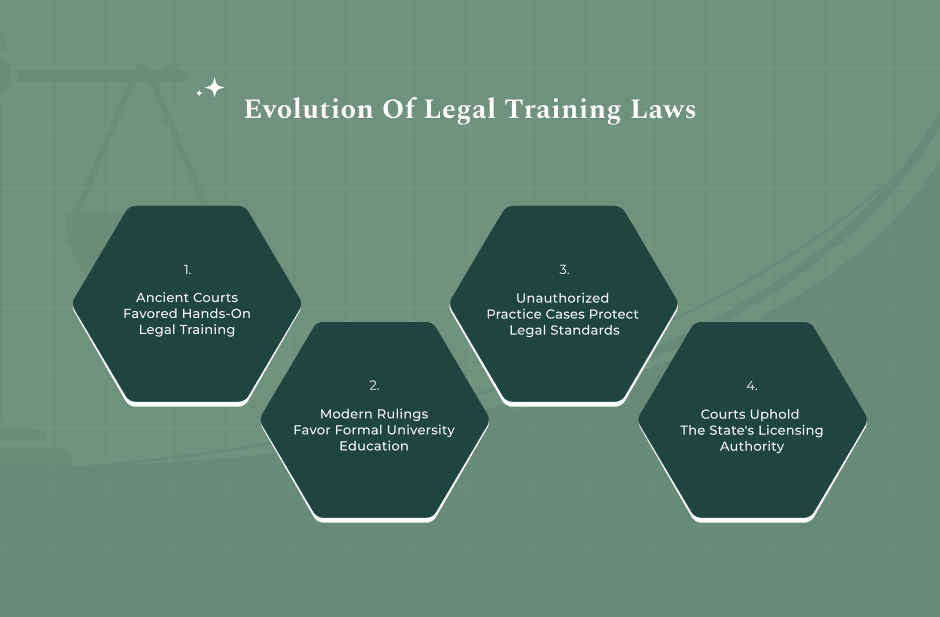
In the past, the most common way of becoming a lawyer was by reading the law. However, as the law became more complex, the requirements for becoming a lawyer became very strict.
Landmark Rulings On Legal Qualifications
In the early part of the 20th century, most states abandoned the apprenticeship system to professionalize the field of law.
The judiciary was of the opinion that the law had become very complex, and a standardized education background was necessary for all lawyers.
Unauthorized Practice Of Law Cases
When an individual attempts to offer legal advice without being licensed, they are subject to “Unauthorized Practice of Law” cases.
Courts have consistently adjudicated against individuals in these cases in order to avoid hurting unsuspecting individuals. A smart individual may cause significant damage with wrong legal advice.
The Case Of Florida Bar v. Brumbaugh
The court examined in 1978 what non-lawyers were capable of doing with legal forms. The ruling stated that non-lawyers could type legal forms but not give advice on which form to fill out. This is an important point for individuals wondering if they can practice law without a law degree.
Modern Challenges To Licensing
Individuals claim that high legal costs are due to licensing. They argue that limited licenses could be used to bridge the justice gap in America. However, most bar associations still struggle to retain the current educational requirements.
Careers In The Legal Field Without Law Degree
You don’t always have to have a law degree to be in the legal system and assist people with their issues.
There are various jobs that enable you to be in the legal system without actually having to be a licensed legal professional. This is an ideal way to get experience and then figure out if you want to get your law degree.
The Role Of Paralegals And Legal Assistants
Paralegals do most of the actual work in the law office. This includes the research and motions. Though they don’t get to sign anything or appear in court, they are the backbone of the legal system. Paralegals make a fantastic living without having to take one law class.
Specialized Legal Tech Careers
The development of technology has led to the emergence of jobs such as legal analysts and project managers.
These are the people who actually understand the law better than some attorneys but don’t practice. They assist law firms in keeping data organized during the course of a trial.
Working As A Court Reporter
A court reporter is responsible for recording all that is said in a court or during a deposition. A good court reporter should have in-depth knowledge of legal terminology. This is an opportunity for you to be at the center of all that is happening without needing any degree.
The Path Of A Legal Mediator
There are states that allow non-lawyers to work as mediators. You could be in a position where you assist people in settling their divorce or contract issues, even if you are not a member of the bar. Communication skills are paramount in this career.
Frequently Asked Questions (FAQs):
If you are interested in the legal industry, you might be interested in the details of the bar exam. For instance, one might be curious if it is possible to practice law without a law degree in every state.
The passing rate is usually much lower because it is extremely difficult for most people to study on their own.
Yes, it is possible in most states to be a mediator without having a law degree. This helps people settle out of court.
Most states require that one have a law degree. The apprenticeship states allow one to take college and several years of study.