The escheat definition is the legal mechanism by which a government or state assumes ownership of unclaimed property or assets from an estate that lacks heirs.
This legal concept prevents property from being stuck in limbo in the event of a person’s death without a will or when a financial account is left untouched for years.
In 2026, many states are revising their escheat statutes to address the growing phenomenon of “digital assets” like cryptocurrency wallets and non-fungible tokens (NFTs).
One of the largest ongoing lawsuits, State of Delaware v. Pennsylvania, is still having an impact on the flow of uncashed checks and money orders through the escheat process across state lines.
With trillions of dollars resting in state unclaimed property funds, you must understand this term to safeguard your family’s financial future.
In this article, we will elaborate on the following:
- The core legal meaning and historical origins of the doctrine.
- How the escheatment process triggers for different types of assets.
- The differences between escheat, unclaimed property, and bona vacantia.
- Practical steps you can take to find and reclaim escheated funds.
What Is Escheat? Legal Meaning And Origins

To grasp the meaning of the escheat definition, we have to go back in history. The word “escheat” comes from the French word “escheir,” which means “to fall out” or occur by chance. In history, if the tenant of the land died without any heirs, the land would “fall back” to the feudal lord.
In modern times, the state is the new feudal lord. The state applies this concept to ensure that the land does not become “ownerless.” Most people experience this concept when a bank account is left idle. The state does not want to keep the money, but it holds it until the owner comes along.
Escheat Definition & Origins
The escheat meaning in modern statutes is the reversion of property to the state on the absence of an individual competent to inherit it (Merriam-Webster).
This happens most often during probate. If a person dies “intestate” (without a valid will) and the court finds no living relatives, the property escheats.
Modern Legal Context
In the 21st century, the definition has been broadened. It now extends beyond death. It also includes “abandoned” intangible property. This may include uncashed payroll checks, dividends, and even the contents of safe deposit boxes. Each state has a particular department, usually the State Treasurer, to oversee these properties.
How Escheat Works – The Process And Timelines

The escheatment process is not something that happens overnight. It is a process that occurs in accordance with a set of escheat laws. These laws state when a business must turn over funds to the government. This is usually in accordance with a “dormancy period.” This is the length of time an account can be inactive before the state steps in.
Conditions Triggering Escheat
Two conditions trigger this process. The first is the death of a property owner who has no will and no heirs. The second is the abandonment of property for a long period of time. This would mean that there are no deposits, withdrawals, or logged-in activity for a bank account for several years.
States’ Role & Custodianship
Most states are “custodians” and not owners. This is an important part of what is escheat in the United States. Although the state can use the interest on the money for public projects, the “principal” amount is available to the original owner or their heirs at any time.
Escheatment Timelines And Property Types
The dormancy period will normally take three to five years. For example, an uncashed check can escheat within one year, while a savings account takes five years. The definition of escheat real property may take a longer legal process to ensure that there are no distant relatives before the title of the land can be transferred to the state.
Escheat vs. Unclaimed Property vs. Bona Vacantia
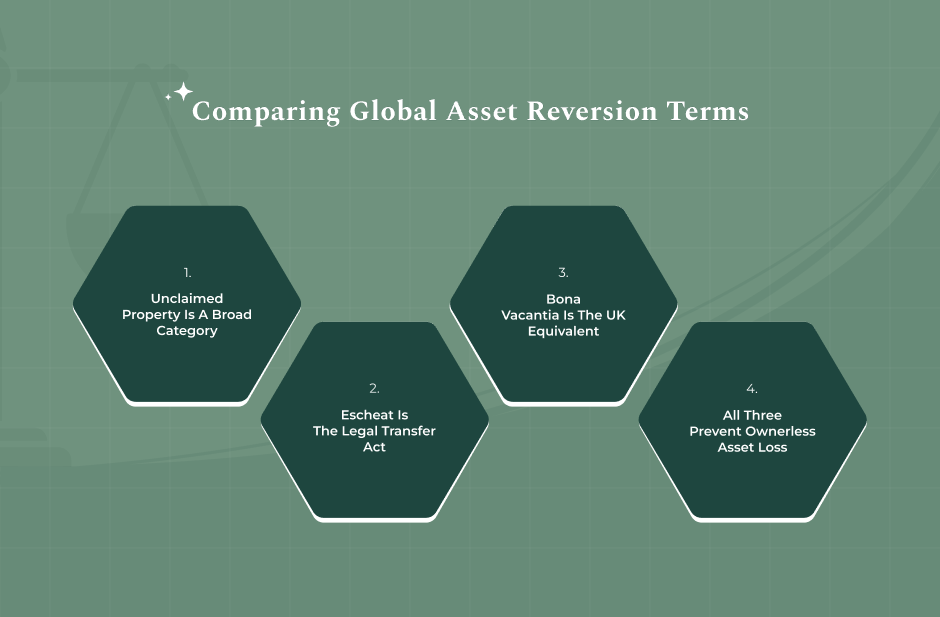
Many people ask, “What does escheat mean compared to unclaimed property?”
Although attorneys will frequently use these terms interchangeably, there are some minor differences in their application around the world. These distinctions are important when tracing assets in foreign nations or under foreign titles.
Escheat vs. Unclaimed Property
Notwithstanding, “unclaimed property” is the more general term. This applies to any asset that has lacked contact with its owner for a very long time.
Escheat is the actual transfer of this property to the state. In most U.S. states, the government retains “unclaimed property” in perpetuity, whereas traditional escheat entailed the state’s ultimate ownership.
Escheat vs. Bona Vacantia
In the United Kingdom and other common law systems, the term “Bona Vacantia” is employed. This is Latin for “vacant goods” (Source: Justia).
Although the effect is the same as the American escheat definition, in the UK, the actual process involves the “Treasury Solicitor” instead of the state treasurers.
Escheat In Estate Law – Intestacy And Succession

In probate courts, the definition of escheat has immense importance. When a person dies without a will, the court applies “intestacy laws” to locate a spouse, children, parents, or cousins.
But if the search ends in a dead-end situation, the property “escheats” to the state government.
Intestate Succession
The state is always the “heir of last resort.” Before the money is transferred to the government, the court typically demands a thorough search for “laughing heirs” – distant relatives who may not even know the deceased.
But if this search also ends in a dead-end situation, the judge signs an order transferring the bank balances and home equity to the state fund.
Jurisdiction Variations
Jurisdictions differ. In India, for instance, the concept of “Lapse” or “Escheat” is regulated by the Seventh Schedule of the Constitution. In the U.S., each state has its own statutes.
For instance, California and New York have extremely aggressive reporting requirements for businesses to ensure that the money is transferred to the state as quickly as possible.
How To Find And Claim Escheated Property
The good news is that you can always get your money back. States now have billions of dollars in escheated funds. You do not need an attorney to look for this money, and it is free of charge through official government websites.
In short, here are the steps to Reclaiming Escheated Assets.
- Search official state treasurer databases online.
- Use MissingMoney.com for multi-state searches.
- Provide valid identification and address proof.
- File formal claims through state portals.
Search Tools And Portals
The first place to look for this money is the National Association of Unclaimed Property Administrators (NAUPA).
They have a website called MissingMoney.com that combines the information of most U.S. states.
You should also visit the “Unclaimed Property” website of each state where you have ever lived or worked.
Claim Documentation
In order to claim your property, you will have to prove that you are the rightful owner. You will have to provide a copy of your ID, your Social Security number, and your former address (such as an old utility bill).
If you are claiming money for a deceased person, you will have to provide the death certificate and proof that you are the executor of the estate.
Expert Tips And Best Practices
To avoid problems with the definition of escheat, you must take the initiative. It is easier to protect your assets from going to the state than to get them back. The main reason for most cases of escheat is simply a change of address or a forgotten password.
- Keep your accounts active: Log into your bank and investment accounts at least once a year.
- Update your contact info: Ensure that all of your financial institutions have your current address and email.
- Write a will: A will can protect your assets from going to the state by naming beneficiaries.
- Cash your checks: Do not let your paychecks or dividend checks sit in a drawer for months.
Read Also: What Is Condemnation? Understanding The Legal Process Of Property Seizure
Frequently Asked Questions (FAQs):
Understanding the escheat definition is essential for anyone managing an estate or long-term investments. These FAQs address common problems and concerns that U.S. citizens face when dealing with state-held property in 2026.
As the laws evolve to cover digital assets, many individuals are left wondering how the government comes to possess their assets. The following questions and answers address the most important contemporary developments in escheat law.
Yes. If real estate escheats to the state because no heirs can be found, the state will sell the property at a public auction. The money from the sale is then placed in the unclaimed property fund.
Even if a legitimate heir comes forward many years later, they can collect the cash value of the property but not the actual house.
In most states within the United States, there is no time limit. You can collect the money 10, 20, or even 50 years later.
However, the state will only retain the original amount. You will not earn interest on the money while it is in the state’s possession. It is always best to collect the money as soon as you discover it.
Yes, but the regulations are more stringent. Since these are retirement accounts, the dormancy period will not normally begin until you turn the age for “Required Minimum Distributions” (RMDs).
If you turn that age and the bank cannot locate you to deliver the funds, the account will eventually begin the escheatment process.
Securing Your Financial Legacy
In conclusion, the definition of escheat is an essential legal term that prevents any property from being ownerless.
Although the concept of the government taking over your personal property may seem threatening, the current legal system is in place to safeguard your funds from being lost for all eternity.
To remain engaged with your financial accounts and have an up-to-date will, you can make sure that your assets remain with you.
If you believe that you have lost funds to the government, you can use the available resources to begin your search. The fact that there are billions of dollars now held by state treasurers indicates that many people are not aware of their “lost” funds.