If you are new to the plethora of legal terms and connotations and are finding yourself confused by all of it, you have reached the right place.
Today, we will talk about one of the biggest legal confusions of all time: Plaintiff vs Defendant.
I am sure that you have heard thine one. In fact, you must have other people tell you how confusing these two can be.
Honestly? Once you understand each of these closely, as we are about to, you won’t find it confusing anymore.
So, let’s get started.
Plaintiff Vs Defendant Definition: Which One’s What?
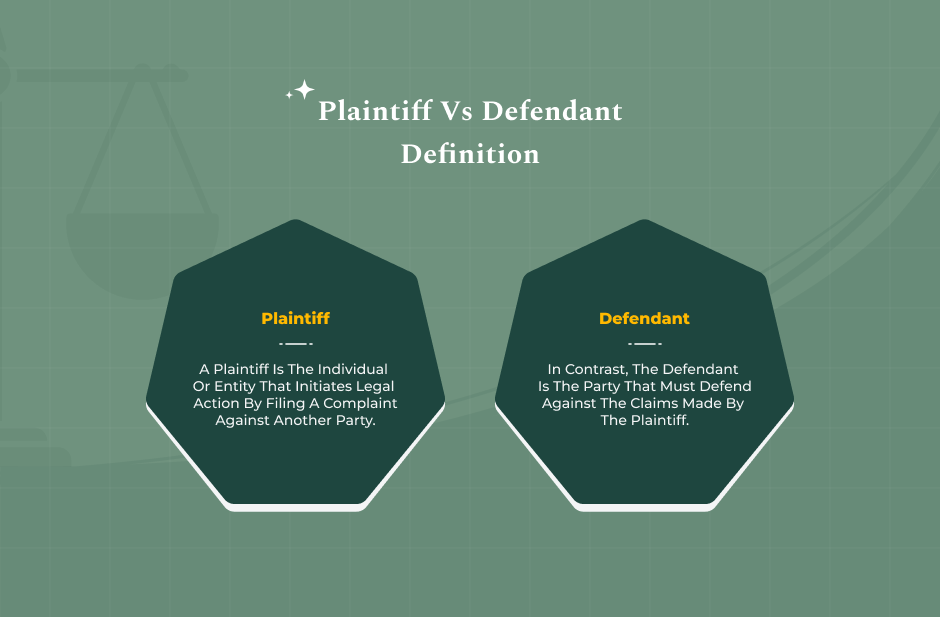
Here, we will look into the plaintiff vs defendant meaning and definitions. This will be the first step in clearing this confusion once and for all.
What Is A Plaintiff?
A plaintiff is the individual or entity that initiates legal action by filing a complaint against another party.
In personal injury cases, the plaintiff seeks compensation for their losses from an individual. (Source: US Claims)
Additionally, it can also be from an organization that you believe is at fault or negligent in the incident that caused the injury.
It is important to note that there can be multiple plaintiffs in a personal injury case, especially in class action lawsuits.
This is where the same issue has impacted a group of individuals, such as product liability.
What Is A Defendant?
In contrast, the defendant is the party that must defend against the claims made by the plaintiff.
The term defendant inherently reflects their role. This is because they are accused of wrongdoing or fault in the matter at hand.
Similar to plaintiffs, defendants can also be multiple in number within a personal injury case.
Plaintiffs often collaborate with personal injury attorneys.
Why? The primary reason behind this is that they want to identify all potential parties that may bear some liability in the case.
Additionally, they also wish to know whether any of these identified parties may become defendants.
Plaintiff Vs Defendant Example: Civil And Criminal Cases
I have given you a table below where I have given you two easy examples of this scenario, in both civil and criminal backgrounds:
| Civil Case Scenario | Criminal Case Scenario |
| This happens during conflicts of interest between individuals and businesses. Let’s say a freelance copywriter (plaintiff) sues a client (defendant) because he didn’t pay for the project even after getting it done. | This happens when people commit illegal actions against the good interests of society or the State. Let’s say you are a burglar who broke into a jewelry store or bank and got caught. In this case, society/the State is the plaintiff and the burglar is the defendant. |
Plaintiff Vs Defendant: What Are The Responsibilities Of Each?
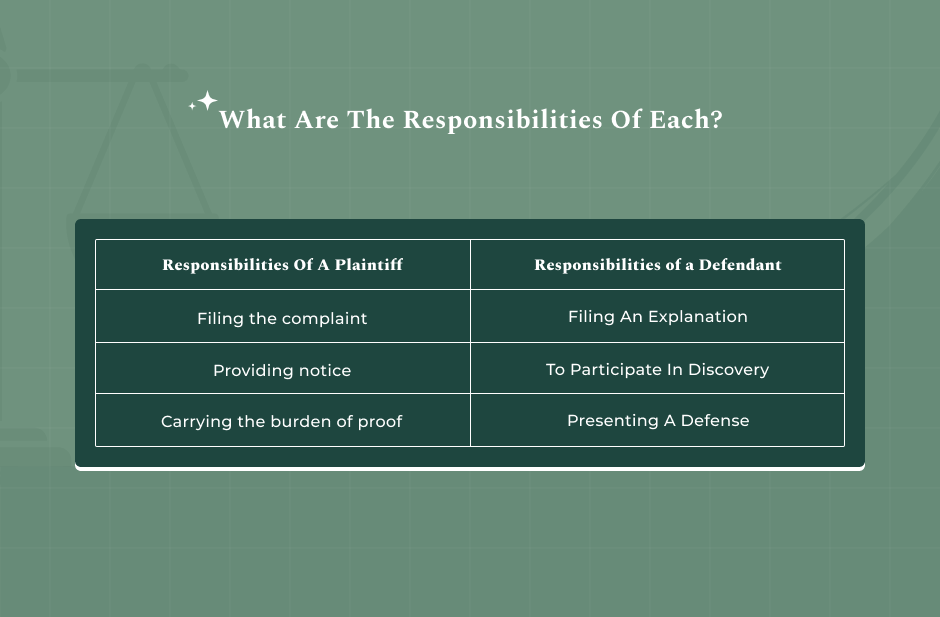
| Responsibilities Of A Plaintiff | Responsibilities of a Defendant |
| Filing the complaint | Filing an explanation |
| Providing notice | To participate in discovery |
| Carrying the burden of proof | Presenting a defense |
In a lawsuit, various parties have specific responsibilities and actions they are expected to take.
The party initiating the lawsuit is known as the plaintiff. Also, they bear the burden of proof. This happens particularly in civil cases.
Moreover, this means the plaintiff must establish that the other party is liable.
Additionally, they must demonstrate a preponderance of the evidence.
Furthermore, legal experts always suggest that it’s important to differentiate between civil and criminal cases.
While the standard in criminal cases is beyond a reasonable doubt, civil cases have a lower burden of proof.
In civil litigation, the plaintiff must show that it is more likely than not that their claims are valid.
On the other hand, the defendant has the responsibility to respond to the plaintiff’s claims.
This involves presenting counterarguments that can prevent the plaintiff from meeting their burden of proof, thereby defending against the allegations made in the lawsuit.
What Is The Burden Of Proof And Who Does It Belong To?
In civil cases, a key distinction exists between the roles of the plaintiff and the defendant. (Source: Kryder Law Group)
The plaintiff typically bears the burden of proof regarding the allegations made.
For instance, if John initiates a lawsuit against Linda for damages resulting from a car accident.
She claimed that she was texting while driving. Therefore, it is not Linda’s responsibility to demonstrate that she was not distracted.
Instead, it is John’s obligation to substantiate his claim that Linda was indeed driving while distracted.
The burden of proof varies depending on the nature of the case. Therefore, legal entities often refer to it as the evidentiary standard.
Moreover, in the majority of civil cases, the plaintiff needs to establish their claims by a preponderance of the evidence.
This standard entails demonstrating that a particular fact or event is more likely true than not.
In certain civil cases, the plaintiff must meet a more stringent criterion known as clear and convincing evidence.
This higher standard necessitates that the plaintiff prove that a specific fact is substantially more likely to be true than not.
What Are Some Plaintiff Vs Defendant Related Terms You Must Know?
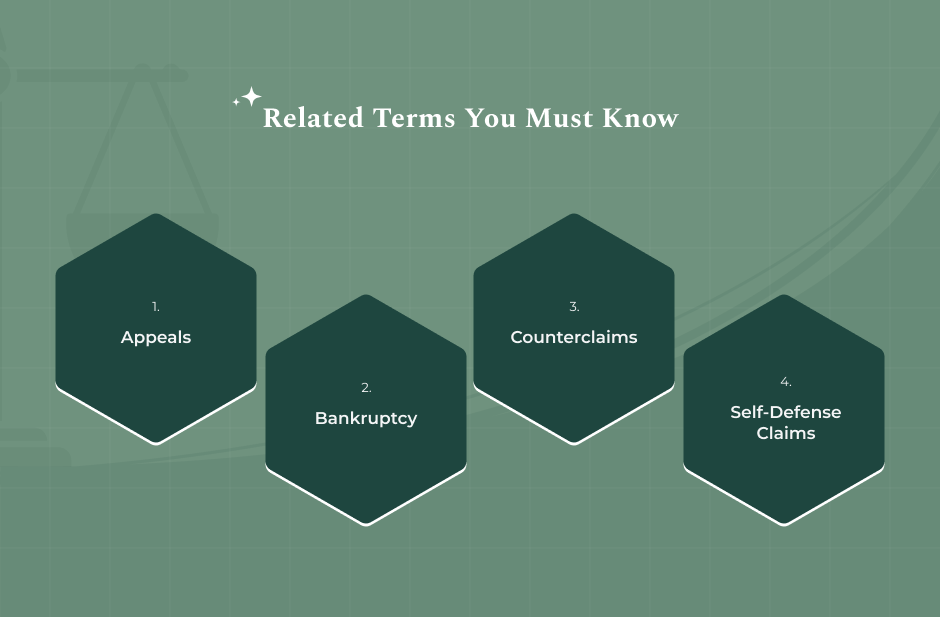
Now that we have a clear idea about the plaintiff vs defendant meaning, it’s time to move on to the next level.
You see, there are specific situations where different terminology is used. Therefore, you must know about these as well:
1. Appeals
In cases that are appealed, the traditional terms plaintiff and defendant are not commonly used.
So here, you will find the term appealing. This involves submitting a written request to a higher court.
You will basically request to alter or overturn a lower court’s decision.
Additionally, the party that initiates the appeal is referred to as the appellant.
Of course, this is regardless of whether they were the original plaintiff or defendant.
Also, the opposing party that responds to the appeal is known as the appellee.
2. Bankruptcy
In bankruptcy proceedings, the terms plaintiff and defendant do not apply.
Instead, the individual filing for bankruptcy is termed the debtor, while the party making a claim against the debtor is called a creditor.
3. Counterclaims
Let’s say a plaintiff sues a defendant. Then, they have the option to file a counterclaim against the plaintiff.
In this scenario, you can refer to the defendant as the counter-claimant or counter-plaintiff.
On the other hand, most legal members often refer to the plaintiff as the counter-defendant.
4. Self-Defense Claims
In civil cases involving allegations of excessive or unjustified use of self-defense, the defendant—who has acted in self-defense—may still face a lawsuit.
In these instances, the party remains the defendant.
But the case’s outcome will depend on whether their actions are deemed to expose them to civil liability for damages.
Read Also: Slander vs Libel – Legal Definitions, Key Differences & Examples
Why Should You Always Be Aware Of The Legal Terminologies?
As the confusion of plaintiff vs defendant gets cleared, I believe that it is time we address the underlying lesson here as well.
When it comes to legal jargon, it is always best to have a clear idea. There is a good reason why.
Let’s say you are a plaintiff in a case. Then, you might not have the time or energy to learn everything at the same time.
But this is exactly the point in time where things are overwhelming, and this is exactly when miscommunications tend to happen.
Therefore, any legal experts that you will come across, regardless of whether they have helped you in any case, will recommend this.
Know what the basic terminologies are. This makes communication more efficient and less time-consuming.
Additionally, you reach a decision faster and with better information.