Is it legal to marry your first cousin is a question that exposes the complexity of American laws regarding the issue, as some states allow it and others prohibit it.
Recently, Tennessee made headlines in early 2024 by passing a law to ban such unions officially. This proves that laws are changing over time.
Many people find the laws confusing because of the different definitions of marriage in each state. You might think that the laws are the same in every state, but that is not true. We will explain the following in this article.
- The specific state laws across the United States.
- The federal government’s stance on marriage regulations.
- Historical case laws that shaped these family rules.
- Common misconceptions and health requirements for licenses.
Is It Legal To Marry Your First Cousin: Federal And State Laws In The United States

Marriage is primarily a state issue, not a federal issue, in the USA. The federal government generally follows state marriage laws for tax purposes.
The federal government does not have any law that states, “It is legal to marry your first cousin.”
Each state decides whether they allow consanguineous marriage or not. This causes a lot of confusion, especially if you move from one place to another. You can be a legal wife in one city, but an outlaw in the next.
The Primacy Of State Authority
Every state has its own laws that it has enacted to describe who is allowed to enter into a marriage contract. While some states allow this practice freely, others make it punishable by law.
For example, in some states, these marriages are termed as “void” from the very start. This means that the state is acting as if it did not happen at all. This makes it difficult for couples to file tax returns and also get insurance together.
The Recent Tennessee Ban Of 2024
In April 2024, Tennessee legislators passed House Bill 2041, which bans first-cousin marriage. This is to fill in a loophole that had been in existence in Tennessee state law for decades.
This means that Tennessee is now part of the majority of states that prohibit these kinds of family unions (Source: Newsweek)
You often hear people wonder which states it is legal to marry your first cousin when making plans for their future. The answer is based on your present geographical area in the United States of America.
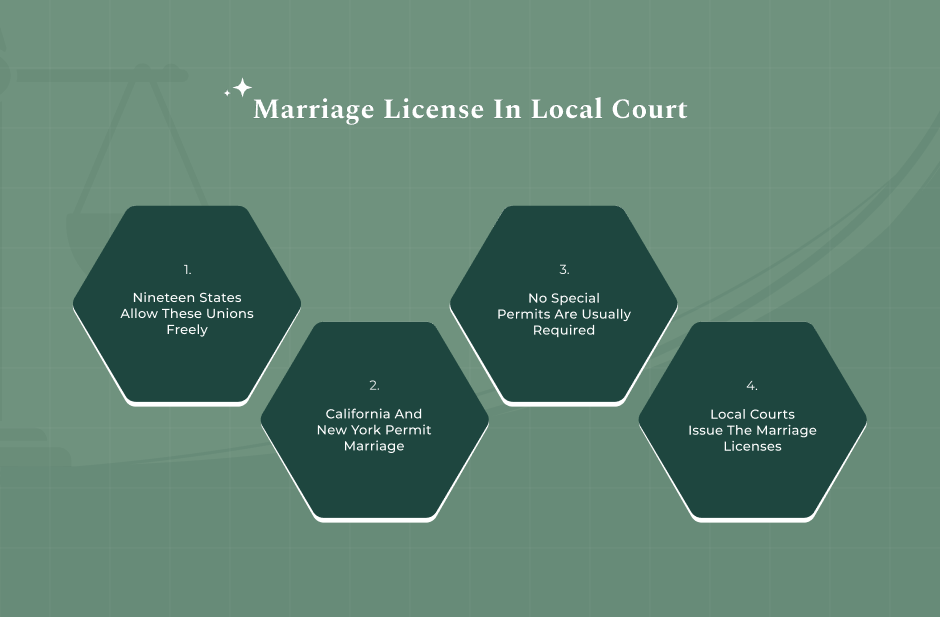
As of right now, there are roughly nineteen states that allow these types of marriages without any major restrictions. These states include:
- New York.
- New Jersey.
- California.
It could make for an interesting family reunion tale if you walked in and received your license just like anyone else in those states.
In Which States Is It Legal To Marry Your First Cousin?
Well, a lot of us get confused in this matter. Is it legal to marry your cousin is a question that is best dealt in state laws, within the purview of Federal laws, that is. So, let us find out a bit more about the state laws in this section.
States With Permissive Marriage Laws
For example, in Alabama or South Carolina, there is no prohibition on cousin marriages. This is because they follow old traditions that emphasize individual choice.
Additionally, most people do not understand that even in New England, cousin marriages are legal.
Massachusetts and Vermont have no prohibition on cousin marriages. It is absolutely legal to marry your first cousin in these places without any fear of prosecution.
States With Conditional Marriage Rules
Some states, like Arizona or Illinois, allow cousin marriages but with certain conditions. For example, in some states, both individuals have to be at least sixty-five years old. Some states demand that at least one of the individuals be sterile.
This is done in an attempt to avoid any genetic defects in future generations. This is a compromise between banning cousin marriages altogether or making them totally legal.
Be sure to check what age requirements there are before buying that expensive wedding ring.
Age Requirements In Arizona
The law in Arizona says that if cousins are at least sixty-five years old, they are allowed to marry. If they are younger than that, they must show that one of them cannot bear children. This is very specific.
Genetic Counseling In Other States
There are possibly a few states that would encourage or demand some sort of genetic counseling prior to the ceremony. This is to make sure that the couple is aware of the possible risks involved for their future children.
This is the medical aspect of the legal process.
Historical Case Law And Judicial Rulings
Case law can give us a glimpse of what judges consider in the issue of whether it is legal to marry your first cousin. One of the things they consider is history in determining the validity of such marriages.
In the past, there were a number of cases dealing with whether a marriage in one state would be valid in another. This is the issue of the Full Faith and Credit Clause of the Constitution.
If you marry in California, does Texas have to recognize you as a spouse? This is the big legal issue.
The Legal Concept Of Public Policy

If you get married in a state where it is legal but reside in a state where it is not, then legal complications will ensue.
The courts will generally decide whether or not your marriage goes against a strong “public policy” in your state of residence.
If your state considers your marriage “incestuous,” it may not recognize your marriage. This could create a legal mess with regard to inheritance laws. It is about your entire legal marriage.
Conflicts Of Laws Between States
States have varying degrees of acceptance for cousin marriages. Some states may recognize your cousin marriage for purposes of a wrongful death lawsuit. However, that same state may not recognize your marriage for purposes of divorce.
This is known as “incidental” state recognition, which is part of complex American family law. It is what keeps lawyers so busy and couples scratching their heads.
It makes you wish you had consulted with an expert in your state.
The Case Of In Re Estate Of Loughmiller
This historical case examined the issue of inheritance in a marriage that was questionable.
The issue before the court was whether a spouse could inherit from the other if the marriage was technically illegal.
Recognition Of Out Of State Marriages
Most states have a tendency to accept out-of-state marriages for the sake of social order. However, the “incest” stigma can be a powerful weapon for states that are against these marriages. It is a contentious issue in most high courts.
Genetic Health And Legal Justifications
Politicians argue about biology when they are making decisions about whether it is legal to marry your first cousin in your state. This affects the way the law is made and carried out in modern society.
The majority of the laws against marrying your cousin are based on the fear of birth defects.
However, modern scientific research has a more complex approach to the risks of marrying your cousin than was previously believed.
The law is slow to catch up with scientific research. It is the old tradition versus new scientific data debate.
Scientific Perspectives In Legislation
Politicians argue that one of the reasons marrying your cousin should be outlawed is because of the genetic risks.
However, some scientists argue that the risks are actually much smaller than the general public believes.
The risks of birth defects are only slightly higher in the general population. However, the “ick factor” seems to be the basis for most legislation.
North Carolina Legislative Discussions
The state of North Carolina continues to be a place where marrying a first cousin is legal, despite various efforts to make changes to the law.
Various representatives in the state have debated the issue in recent times in order to address concerns from the public and make the laws consistent with those on family matters.
It continues to be a hot topic in the state legislature every few years.
Arguments For Prohibiting Unions
The arguments in support of prohibiting such unions are centered on the cost to the healthcare system, as genetic problems could necessitate costly care. This is a financial argument for prohibiting such unions.
Arguments For Marital Freedom
The arguments in support of allowing such marriages are centered on the government having no place in the bedrooms of citizens.
Adults should be able to choose their partners, they argue. This is a liberty argument that most Americans would support.
Essential Lists For Understanding Marriage Laws
It is always important to be informed in order to avoid any legal problems in the future. This is a breakdown of the current state of affairs in the country.
States Where First Cousin Marriage Is Totally Legal
So, let’s find out about the states in this detailed lists.
- California and Colorado
- Connecticut and Florida
- Georgia and Maryland
- Massachusetts and New Jersey
- New Mexico and New York
- Rhode Island and South Carolina
- Vermont and Virginia
Requirements For Conditional Marriage States
Now, about the requirements. Let’s know more, shall we?
- One partner must be over sixty-five.
- The couple must prove they are sterile.
- Both partners must be of a certain age.
- Genetic counseling may be a requirement.
Social Perceptions And Media News
The social aspect of is it legal to marry your first cousin is as complicated as the legal part. Public perception is often quicker to change than the laws themselves in most parts of America.
You may find that your community is more judgmental than the judge in court. The news and movies often portray these kinds of relationships in a bad light.
This is something that many people have to face in their daily lives.
Media Coverage Of Recent Ban Attempts
The news media tends to report these cases with a sense of curiosity and legal analysis. This is helpful in giving the public an idea of the changing nature of family law in their jurisdiction. When Tennessee enacted its law, it became a trending topic on social media for days.
Everyone likes to discuss the ethics of these laws online. It simply proves that the question of is it legal to marry your cousin is highly relevant.
The Role Of Tradition In Modern Law
Most of these laws banning cousin marriages were enacted in the nineteenth century. These are simply an expression of social values of a particular time period in American history.
Today, some people feel these laws are outdated and should be abolished. Others feel these are vital in maintaining tradition in American families. It is a debate that combines religion, science, and individual freedom in one sense.
Common Questions About Cousin Marriage Laws
However, many people still have questions about whether it is legal to marry your first cousin in today’s world.
Here are some answers to the most common legal questions from people across the country. We hope these easy answers will help you understand the complicated rules.
Yes, you can get married in a state that allows it, but your state will not recognize your marriage.
The IRS will usually follow state laws, which means that if your state prohibits it, then you could lose some joint filing benefits.
You have to follow the laws of the state in which you reside in the US if you want your marriage to be valid.