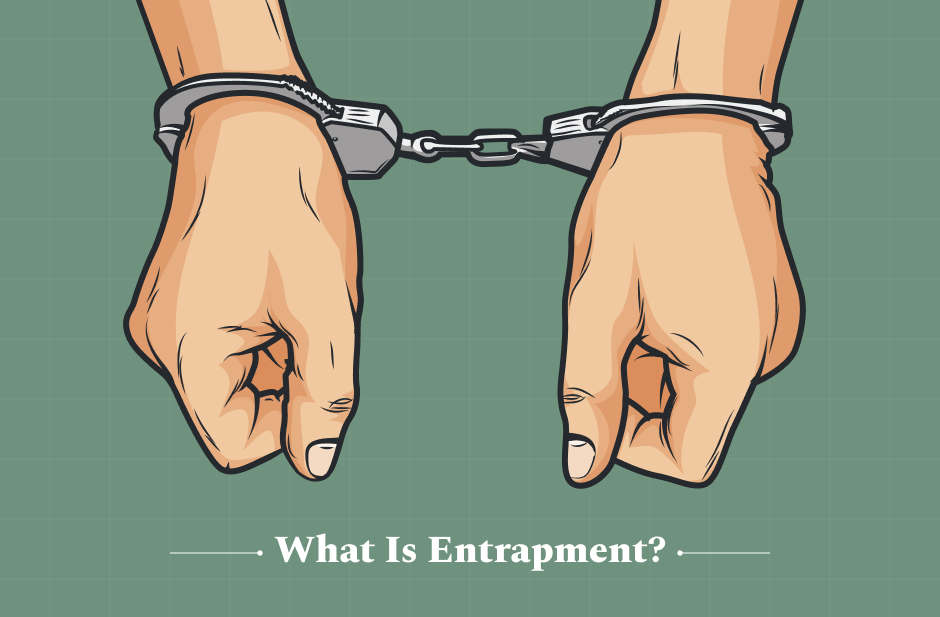
What is entrapment in the eyes of the modern justice system?
This intricate legal defense works when government agents encourage someone to commit a crime that would have otherwise been avoided. It’s not just about police being “sneaky” or undercover.
It’s actually about due process and how it’s breached when the intent to commit a crime is created by the state.
Currently, there are a host of high-profile legal showdowns that are propelling this topic into the spotlight. In the “Operation Digital Shadow” federal case, defense lawyers are claiming that in 2026, agents, through psychological coercion, induced these individuals into computer crimes.
Importantly, if there is a ruling that the government’s actions were overzealous, then these charges against these individuals might be entirely dropped.
Knowledge of what is entrapment and these limitations is integral to the preservation of civil liberties, as well as holding authorities accountable.
In this article, we will elaborate on the following:
- The formal legal meaning and how it differs from common misconceptions.
- The specific elements required to build a successful defense in court.
- Differences between the subjective and objective tests used by judges.
- How to distinguish between a legal sting operation and illegal inducement.
What Entrapment Means In Law
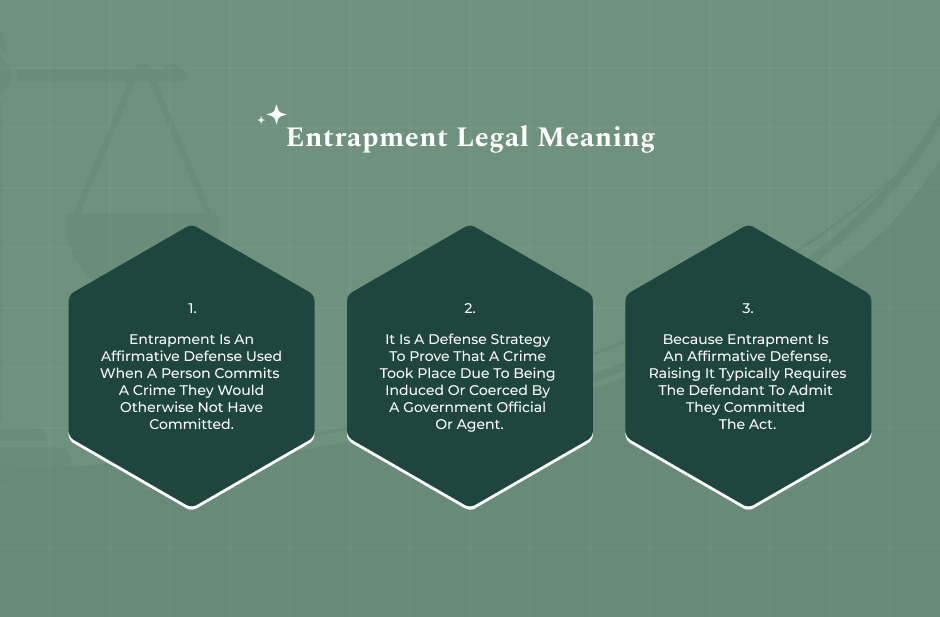
In order to understand what is entrapment, it is necessary to consider that entrapment serves as a “shield” rather than a crime itself.
The meaning of entrapment refers to a situation in which the government oversteps its role as a protector and becomes a provocateur of illegal acts. (Source: Cornell Law School, Wex)
What Is Entrapment – Legal Definition and Core Concept
The definition of entrapment focuses on the origin of criminal intent. The defense applies if the idea for the crime originated with the police, and they induced an otherwise innocent person to carry out the crime.
Entrapment law still focuses on whether the defendant was “ready and willing” to commit the crime when the police arrived.
Dictionary vs. Legal Meaning
While the meaning of the word “entrap” as defined by the dictionary can mean the mere act of catching an individual with a trap, the circumstances are certainly limited within the field of law. Legally speaking, the individual has to have been “lured” or coerced by a government agent.
Key Elements Of Entrapment Defense
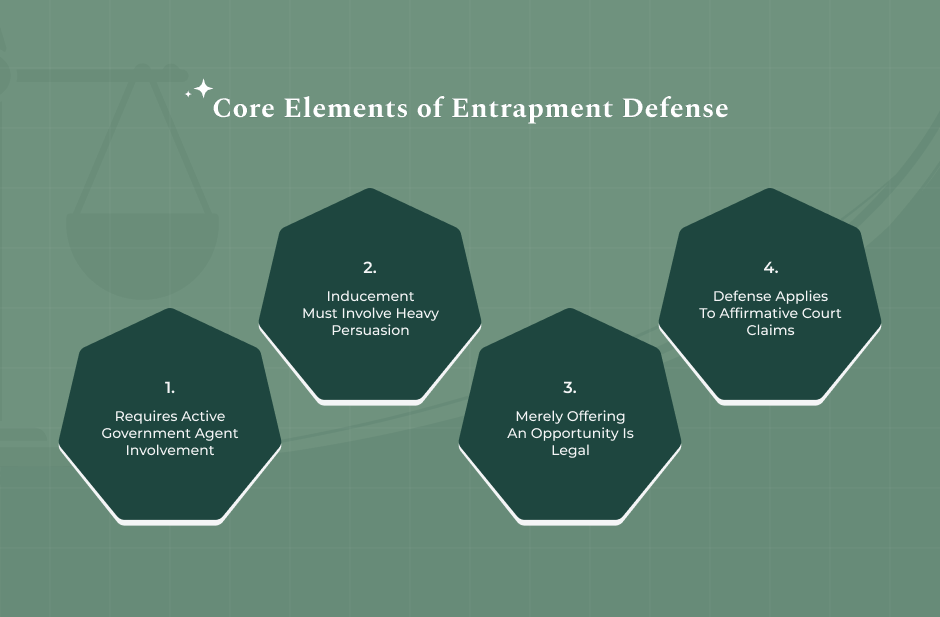
When a lawyer attempts to describe to a jury or to a decision-maker what is entrapment. There are certain inherent qualities ensuring that it does not fall into the hands of criminals as a means to get away with their crimes. It seems to shift to an evidentiary standard during a criminal trial.
Government Agent Involvement
To effectively perform this defense, the individual performing the luring activity must be an officer of the law or an informant.
Therefore, your neighbor enticing you to commit an illegal activity will not be considered entrapment under the current entrapment laws. Finally, the government must be the culprit. (Source: U.S. Department of Justice, DOJ)
Inducement vs. Opportunity
This is probably the critical component in the answer to your question, “what is entrapment?” A “mere opportunity” to commit a crime is perfectly legitimate.
For example, an undercover cop waits at a corner as a decoy to pose an opportunity to someone.
Inducement is persuasion by threats or intimidation, or appealing to someone’s sympathies and causing them to make a choice.
How Courts Evaluate Entrapment
Was the illegality of entrapment an issue of court standards?
No, because the court standards involve two different tests in determining whether the entrapment defense was valid.
This depends on whether the jury looks at the police’s actions or the defendant’s character in state or federal courts.
Subjective Test (The Majority Rule)
Most courts across America follow the “subjective test.”
In that, we ask, “Was this individual predisposed to commit this crime?” If an individual has a long list of similar offenses, the jury will probably not believe their defense.
They will probably believe the individual was searching for a way to violate a law and just saw an opportunity to do so.
Objective Test (The Minority Rule)
A smaller number of states offer the objective test.
The purpose of the test is not concerns of the past. The question that the test asks is, “Would the police’s conduct have tempted a normally law-abiding person to commit a crime?”
If the police’s conduct was just too extreme to resist, the case is immediately dismissed. (Source: Britannica)
Entrapment vs. Sting Operations
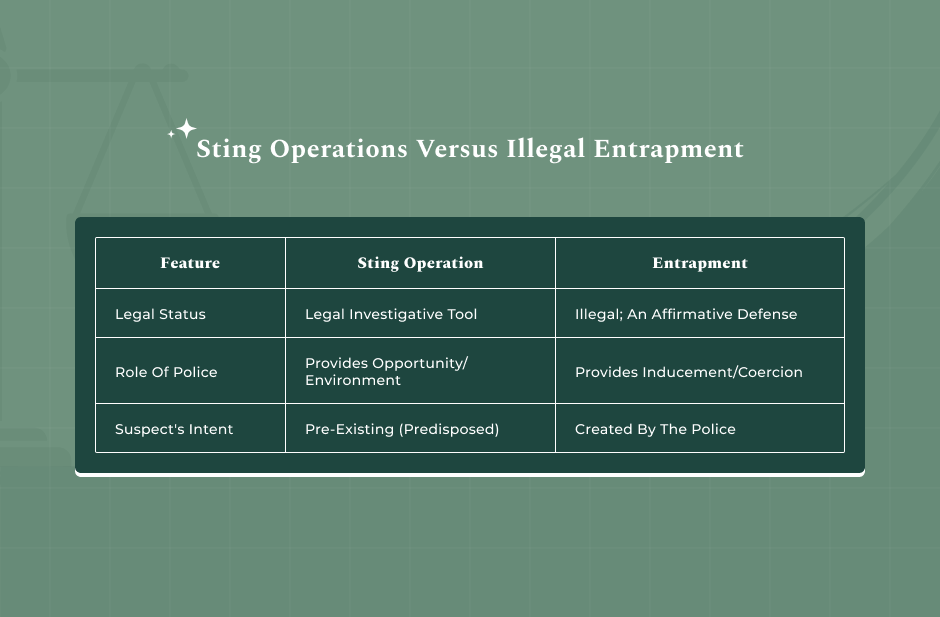
Confusion often results about what entrapment is with the term “sting operation.” Most citizens have the misconception that a sting operation is always against the law.
However, a sting operation is an important and legal measure the police take to catch criminals who are currently operating within the illegal market.
Definition Comparison
Sting operations surprise criminals “in the middle” of their natural pattern of crime. Sting operations under the theory of entrapment are legal due to the intent of the crime being preexisting within the person being investigated.
Unlike this, the theory of entrapment involves the police instilling intent within the person to commit the crime.
Real-World Examples
If an undercover agent is selling the goods to a fence, it is a legal sting operation. If an undercover agent follows a law-abiding citizen for a week, begs the citizen to buy the goods, and tells them it is to save his sick child, it is Entrapment. The key factor here is the degree of pressure.
Step-By-Step Guide To Proving Entrapment
If accused of a crime, it is necessary to understand the manner in which the crime can be proven to have constituted “entrapment.”
Entrapment is considered an “affirmative defense” because one assumes guilt but claims the crime was the fault of the government. One is required to offer credible information to have the proceedings progress.
1. Establish Government Contact: Prove that the person who suggested the crime was an agent/informant.
2. Show inducement: Procure evidence of the excessive pressure, such as a recording, text, etc.
3. Demonstrate a lack of predisposition: Demonstrate your lack of a history or interest in this particular type of crime.
4. Rebut Prosecution Claims: Anticipate the prosecution will try to raise your past history of being “willing” as a mitigating factor.
What Is Entrapment – Understanding Through Case Law And Historical Milestones
The evolution of the legal principle of entrapment has been influenced by the Supreme Court over the past century.
These cases set the limits on the manner in which the police can engage the public. They also guarantee the government is not creating crime to bolster their stats on convictions.
Sorrells v. United States (1932
This was the first important case to address this defense claim. During Prohibition times, an undercover agent begged an individual several times to acquire him some liquor.
The individual eventually relented after being told that they belonged to the same military unit. According to the Court, a crime was created by “persistent solicitation” performed by the agent. (Source: U.S. Supreme Court, Sorrells v. U.S.).
Jacobson v. United States (1992)
In this case, the government spent two years sending letters to a man to persuade him to buy illegal materials. He eventually did so.
The Supreme Court ruled this was entrapment. They stated that the government cannot spend years “breaking down” a person’s resistance to find a crime.
Frequently Asked Questions (FAQs):
There are questions that people ask about their rights in dealing with undercover police officers. Here are some frequently asked questions about what constitutes entrapment and the legality of police conduct in 2026.
When dealing with law enforcement, it’s essential to recognize the difference between a legitimate inquiry and illegal activity. The following are the explanations to commonly asked questions to help clarify certain legal boundaries for the average citizen.
No, this is not entrapment. Police are allowed to say whatever it takes to investigate. Only that meaning of entrapment would apply to you when police pressure you to commit a crime. Not just because of their dishonesty about their ID.
No. This only protects the government, and in such a case, a private individual tricks or forces someone into a crime, and then he or she has defenses such as duress, but it does not constitute entrapment.
The act of entrapment is not illegal, nor is the arresting officer arrested on a charge for doing so. The ‘illegal’ arrest is that it can’t be prosecuted.
However, if a judge finds that entrapment is present, he dismisses the charges, thereby ‘punishing’ the police for their actions.
Entrapment – Balancing Law And Justice
In summary, knowing what is entrapment is a powerful tool for any citizen. It is also a check on government power, forcing law enforcement to look to catch the criminals, rather than creating them. It is within a police officer’s rights to utilize undercover police work and sting operations.
However, they may not use strong-arm tactics or harassment in order to weaken someone’s will.
Knowing the elements of inducement and predisposition will help you protect your rights. As new technologies evolve the legal landscape in 2026, knowing these precedents becomes even more important.
If you feel that you have been the victim of government luring, it is important to speak with a legal professional who can help determine your defense.