The writ of certiorari is the most important tool utilized by the United States Supreme Court in deciding which cases are of sufficient value to warrant review.
This court mandate allows the superior court to review the records of the lower court to ensure that the law was properly applied.
As we enter the first few months of 2026, the legal world is buzzing with a number of high-profile petitions.
The case of Sripetch v. SEC and the landmark case of Trump v. Cook show the ongoing importance of the writ of certiorari as the “final gatekeeper of justice in America.”
Because the Court grants only a very small percentage of petitions, it is essential to understand the rules for any legal aficionado. In this article, we elaborate on the following:
- The historical origins and the literal certiorari meaning in common law.
- The procedural steps involved in filing a petition for certiorari.
- The “Rule of Four” and other criteria are used by justices to grant review.
- Key differences between this writ and other legal remedies.
What Is A Writ Of Certiorari?
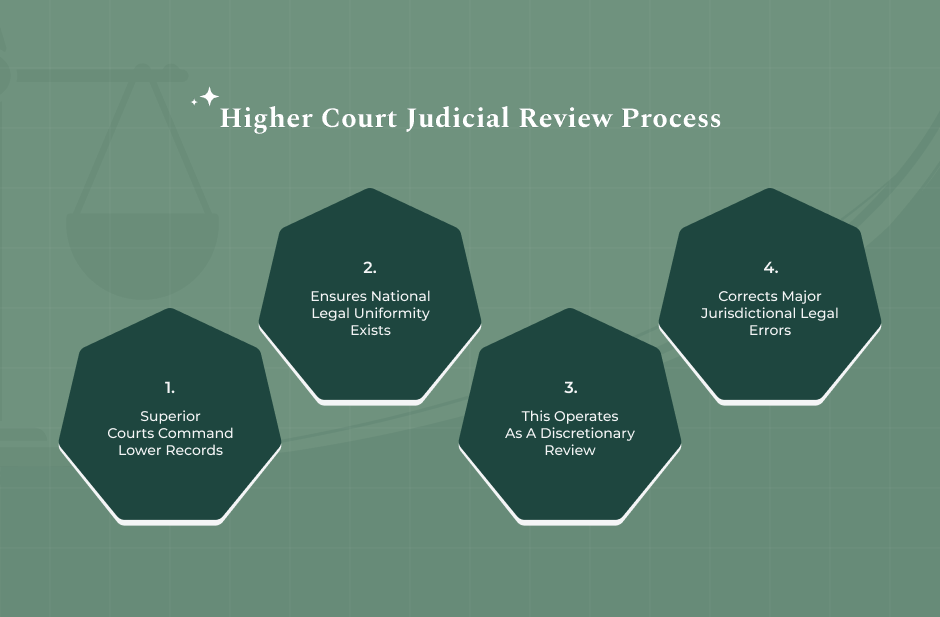
The writ of certiorari is a court order issued by a superior court to an inferior court to send up the record of a case.
This ensures that the higher courts are able to monitor the lower courts and have a uniform interpretation of the law throughout the land.
Most people are familiar with this term as it relates to the U.S. Supreme Court, where it is a discretionary review process.
It is not an automatic right but rather a judicial discretion to review major legal mistakes or constitutional issues.
Origin & Historical Background
The origin of the writ of certiorari dates back to the early days of the English legal system.
The writ of certiorari started as a means by which the King’s Bench could stay “certified” of the proceedings in local and manorial courts.
When the American legal system developed, it followed these common law traditions to deal with judicial hierarchy.
This is why the writ has so much importance in our contemporary legal system.
Latin Roots & Common Law Origins
The name of the writ is derived from the Latin word certiorari, which has the same meaning as certiorari, that is, “to be informed” or “to be certified.”
In medieval England, the King would employ this writ to remove a case from a local court to the King’s court for a final review.
What Certiorari Does – Function & Purpose
The primary purpose of a writ of certiorari is to ensure that the legal reasoning applied by lower courts is sound. It enables the highest court to intervene in a situation where a decision is likely to cause instability in the legal system.
The power exercised by higher courts is used to end “circuit splits,” which occur when two different circuit courts apply the same law differently. This ensures that federal law is uniform across all states.
Erroneous Correction And Legal Uniformity
The court employs the writ of certiorari to correct “palpable” errors of law that might impact millions of people. Through case selection, the justices are able to resolve constitutional issues that are beyond the capabilities of lower courts to decide.
How The Certiorari Process Works
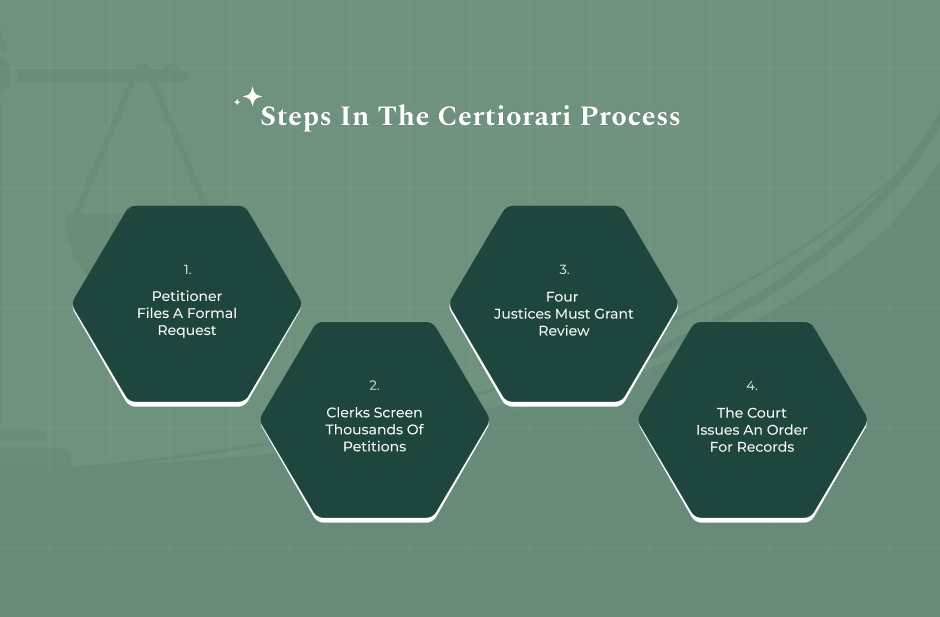
The process of a writ of certiorari begins with a losing party who feels that their case is relevant to an important point of law. This party is known as the “petitioner,” while the winning party in the lower court is the “respondent.”
The process is very selective and consists of several levels of screening by law clerks and justices. Only the most exceptional cases make it past this rigorous screening process to oral arguments.
Filing A Petition For Certiorari
First, an attorney must file a petition for certiorari. The case in the petition has to be “certworthy.”
Rule Of Four (U.S. Supreme Court)
The writ of certiorari is decided by the “Rule of Four.” If four or more of the nine justices believe that the case is important, then the court will issue the writ.
Cert Pool & Clerk Review
Most justices participate in a “cert pool” where their clerks review the thousands of petitions that the court receives every year. The clerks summarize the cases and make recommendations.
Criteria For Granting Certiorari
The Supreme Court does not grant a writ of certiorari to correct all minor errors. They look for cases that have important implications for the entire country or the future of the law.
Petitioners must show that their case is the best “vehicle” for answering a certain question of law.
Not A Matter Of Right
As every attorney is well aware, a writ of certiorari is not a right. The court rejects about 99% of petitions for certiorari, and a “cert denied” is not worth the paper it is printed on as far as the merits of the case are concerned.
Certiorari In Different Jurisdictions
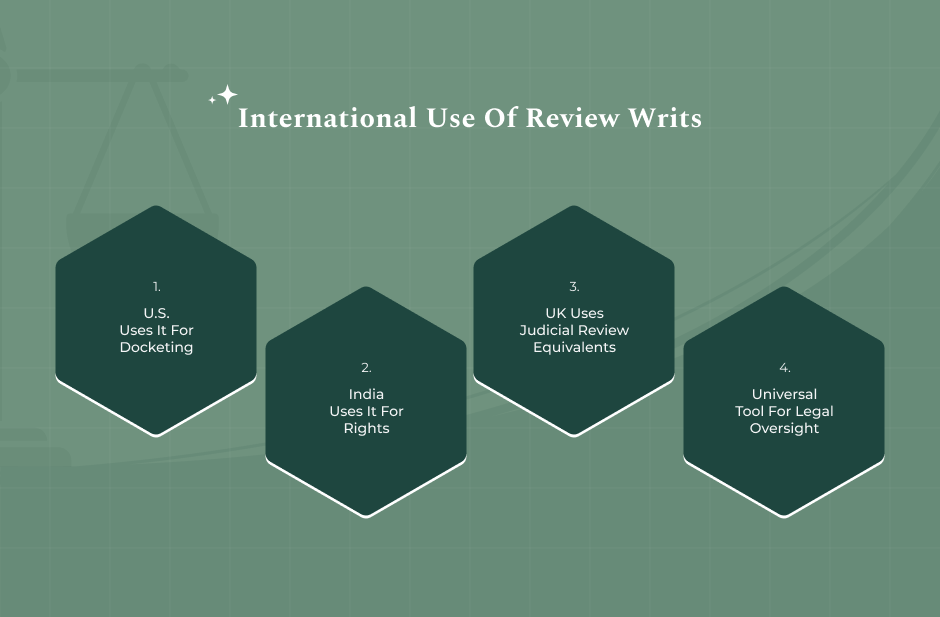
The writ of certiorari is not an exclusive practice in the United States. In fact, many nations that have a common law system employ a similar practice to keep order in their court hierarchies.
The specific practice regarding the issuance of the writ can differ greatly from country to country. Some nations employ it for administrative purposes, while others employ it for constitutional purposes.
United States Supreme Court
In the United States, certiorari is a tool to control the 7,000 petitions each year. Out of this, only 60 to 80 cases make it into court.
Commonwealth & Indian Context
In India, the writ of certiorari is a constitutional remedy provided under Articles 32 and 226.
The writ of certiorari is used to quash orders passed by inferior courts or tribunals that have overstepped their jurisdiction or acted in contravention of natural justice.
Other Common Law Jurisdictions
In the United Kingdom, the traditional writ has been replaced by modern “judicial review” procedures.
However, the essence of the matter remains the same, as the high courts still remove cases from lower tribunals to ensure that they are following the law correctly.
Certiorari vs Other Writs & Remedies
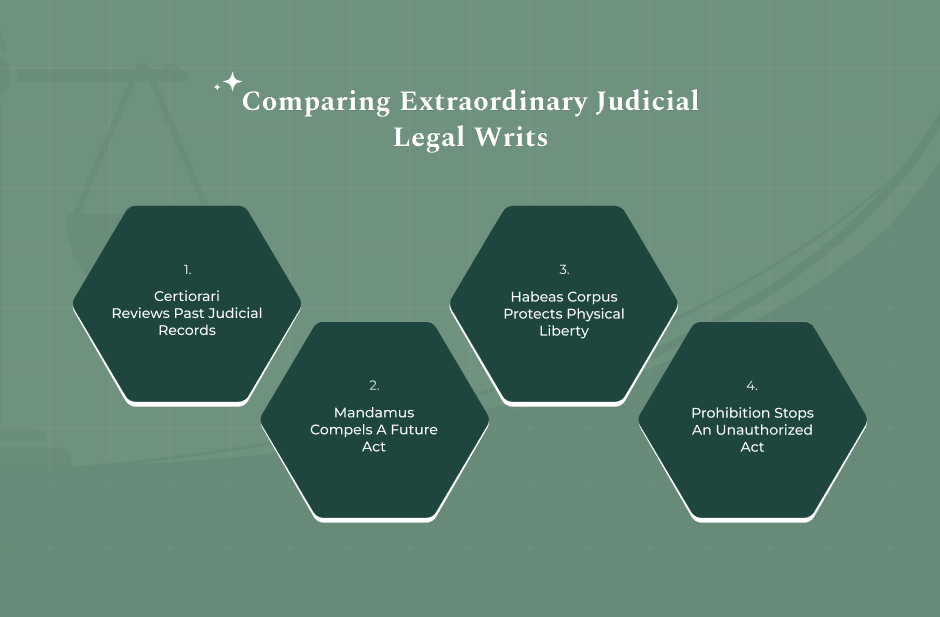
The writ of certiorari is one of the “extraordinary writs” that are present in the legal system.
Each of these writs has a different objective and purpose, and if the wrong one is used, it will automatically be dismissed.
It is necessary to understand the differences between these writs in order to have a complete knowledge of administrative law.
Although all of these writs are issued by a higher authority, they all command the lower courts in different ways.
Certiorari vs Mandamus
Although a writ of certiorari is utilized in reviewing a decision that has already been made, a writ of mandamus forces an individual to make a decision that they are intentionally refusing to make.
A writ of certiorari reviews an error that has already occurred, while a writ of mandamus reviews an obligation that has yet to be fulfilled.
Certiorari vs Habeas Corpus
Certiorari is related to the legal record and judicial reasoning that is employed in a decision. Habeas Corpus, on the other hand, is related to the physical liberty of a person.
Practical Examples & Case Scenarios
To understand what a writ of certiorari looks like in practice, we can turn to examples of civil rights cases or corporate regulations.
These examples illustrate how the writ goes from being a Latin phrase to a life-altering decree.
In many instances, one writ can alter the lives of millions of people. By choosing to hear one case, the Supreme Court can strike down laws in all fifty states at the same time.
Federal Circuit Split
If the 2nd Circuit makes one decision on a privacy statute, but the 6th Circuit makes another, the Supreme Court will issue a writ of certiorari.
This occurred in 2026 in the case of Salazar v. Paramount Global, involving digital newsletter subscribers.
When a president tries to remove a governor of the Federal Reserve, the Supreme Court will frequently intervene through the writ of certiorari.
This occurred in the case of Trump v. Cook, involving the independence of the central bank.
Denial Of Certiorari Explained
When an individual loses a straightforward breach of contract claim and attempts to appeal to the Supreme Court, they will probably receive a “cert denied.”
This example of a writ of certiorari illustrates how the court will not hear cases that lack a significant “federal question.”
Expert Tips & Best Practices
Writing a successful petition for certiorari is one of the most difficult challenges in the law.
It takes a lawyer to be both a scholar and a storyteller, persuading the justices that this case is the most significant one on their plate.
Successful petitions usually emphasize the “big picture” and not the particular injustice suffered by the client. The justices are interested in solving problems for the nation, not for the individual.
- Emphasize the Split: Clearly demonstrate that the lower courts are in conflict with each other. Use an example of a writ of certiorari from another circuit to demonstrate the confusion.
- Focus on the Question: Keep the “Questions Presented” section brief and focus on a general legal issue.
- Respect the Deadline: Never miss the 90-day deadline. The court is very particular about timing in 2026.
- Simplify the Record: Make it easy for the clerks to spot the legal error. A messy record is a quick way to get a denial.
Frequently Asked Questions (FAQs):
The realm of high-level appeals can be very confusing for the layman. These questions will help clarify some of the points of contention regarding the writ of certiorari and the Supreme Court in 2026.
No, it does not. When the court denies the writ of certiorari, it is not a “ruling on the merits.” It simply means that for one reason or another, the court chose not to review the case.
Yes, this is called a pro se petition. Thousands of these are filed each year, but very few are ever granted. The writ of certiorari is not easily understood by non-attorneys. But the court has special procedures for “in forma pauperis” to help those who cannot afford lawyers.
After the writ of certiorari is granted, the lower court will then send the case record to the Supreme Court. Next, both sides of the case will then file “briefs on the merits.”
Finally, the case will be scheduled for oral arguments, in which lawyers will argue their side of the case before the nine justices. A decision will be rendered in writing several months later.