Parole vs probation is one such issue that brings about much confusion among people who do not deal with legal issues on a regular basis. Though parole and probation both mean that the convicts do not spend their time behind the bars, they provoke entirely different reactions within the legal system at different levels.
Article Summary:
- Sentence Timing: Probation may substitute the prison sentence, while parole may follow the prison term.
- Supervision Authority: The judges are responsible for supervising the probationers, while the boards
- Legal Fallout- Missing or violating either can result in direct incarceration.
- Rehabilitation Objectives: The objective of both is to socialize people safely.
Parole Vs Probation – What Is Parole?
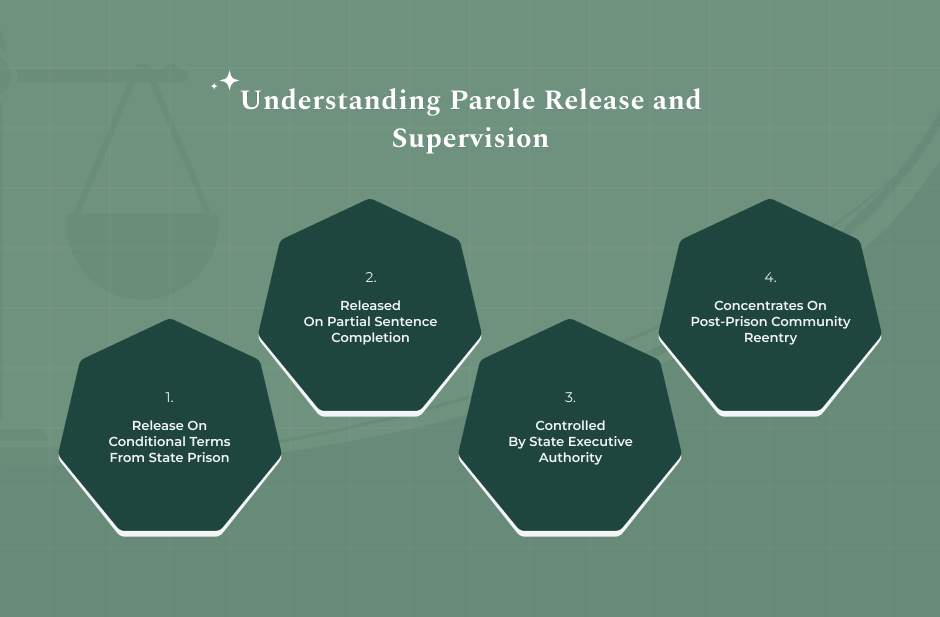
Parole is also known as parole release. This is a conditional release of an inmate who has served a substantial part of their sentence. This is done to make it easier for them to serve out the rest of their sentence in the community while undergoing strict supervision.
Parole vs Probation – Definition and Purpose
This is under the discretion of the state and based on the prisoner’s conduct and chances of successful reintegration. This is a motivational tool within correctional facilities to influence positive prison behavior and control prison populations (U.S. Department of Justice).
The Role of the State
It is usually under the care of a dedicated public agency to assure the safety of the public. Understanding the differences between parole and probation will help one comprehend that parole is a continuation of a sentence and not an substitute for a sentence.
What Is Probation?
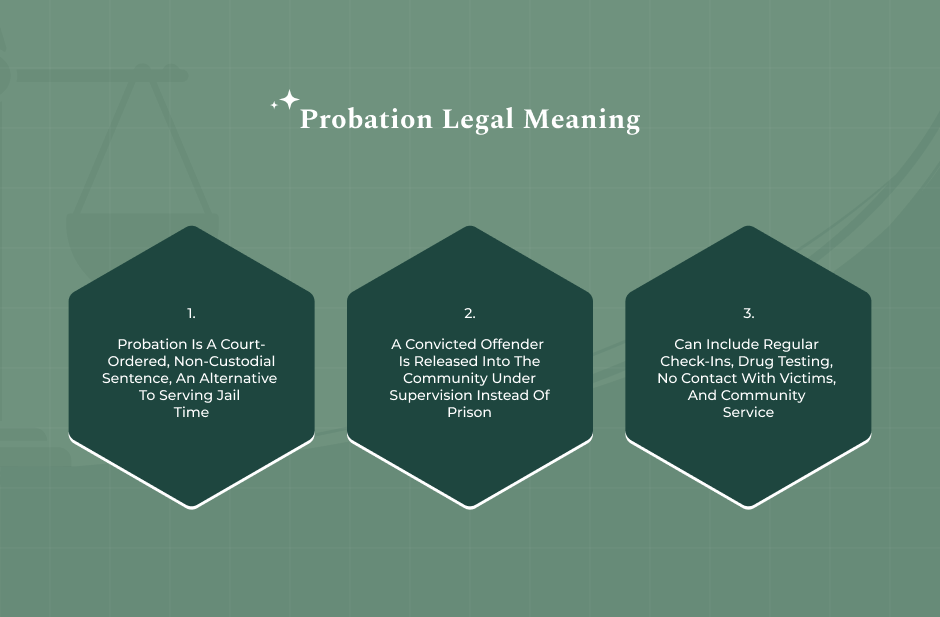
Probation is a community supervision sentence imposed by the court, which is typically imposed instead of a jail or prison term.
A judge holds a person in the community but under strict guidelines.
A Court-Ordered Alternative
Essentially, the judge gives the offender probation in hopes of the individual proving they can comply with the law. Of course, this will primarily happen to first-time offenders or those who committed a non-violent crime (American Bar Association).
Community Supervision Basics
The offender is under the close supervision of the legal system without ever going to a cell. In the parole vs probation comparison, it is important to include the fact that parole begins after the parolee has served a certain term of their sentence. Remember that probation can begin immediately after the sentence begins.
Main Points of Comparison Between Parole and Probation
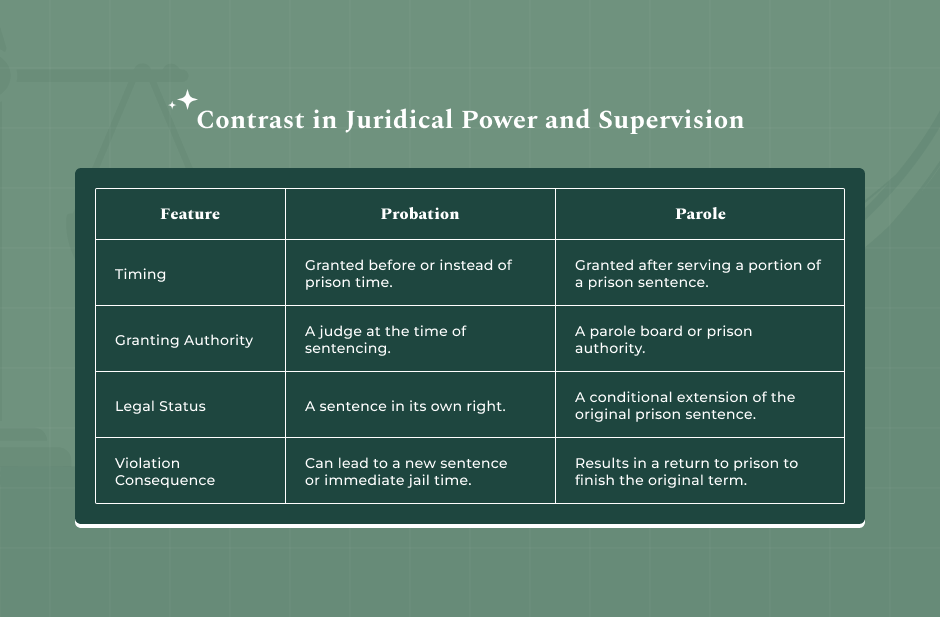
Although there is a similarity in the two terms, the main distinction between probation and parole involves the “when” and “how” of supervision. Also, one involves pre-prison alternatives, while the other involves post-prison alternatives.
Timing and Application
Probation is always part of the initial sentence given by the judge immediately following the conviction. On the other hand, the case of parole vs probation presents a transition of power whereby the possibility of parole only arises after serving a time in a correctional institution.
A judge retains the authority to grant, change, or withdraw probation because it is judicial authority. Yet, it is the parole board, an agency of the executive branch, that has the authority to grant paroles as informed by institutional files and hearing testimonies.
Conditions and Violations
In addition, the individual is required to meet with an officer, remain employed, and be drug-free. Failure to comply with these requirements will result in the individual having to go to a “revocation hearing,” and this may result in the individual serving a long jail sentence.
It is important to comprehend the difference between parole and probation after considering the concept of each.
Parole & Probation in Action
In the real world, these programs look very much like your average neighbor. A person on parole versus a person on probation could be working and living in a standard apartment and reporting to an office.
The Officer’s Role
The difference between a parole officer and a probation officer is primarily dependent on who their employer is. The probation officer is a court-based professional tasked with monitoring individuals who have escaped imprisonment.
A parole officer is a state correction department professional who is responsible for monitoring individuals released from prison. Both officers are required to carry out home visits and substance testing to ascertain community safety (EBSCO).
Rehabilitation in Action
Helpful aspects of supervision include placement services and mental health counseling. If we consider both parole and probation, we can see that in every case, the final aim is to stop the individual from committing any kind of crime again.
Read Also: Attorney vs Lawyer: How to Know Which Legal Help You Need?
Legal and Social Consequences
Being supervised influences one’s rights as well as public perceptions regarding a person. The aspect of being supervised is a fine line between giving a second chance and ensuring there is law and order.
Restricted Rights
Persons on parole versus probation may waive some of the rights granted by the Fourth Amendment, allowing law enforcement to search their homes without the need for a warrant. They also have restricted travel, requiring them to seek permission from the authorities to leave the county or the state.
Social Stigma and Success
Supervision might make it difficult to get a job due to the fact that they have to be monitored on a consistent basis during work hours. Nonetheless, individuals who complete their term of parole vs probation have a chance of not reverting to a life of crime.
Parole vs Probation: Expert Insights And Best Practices
According to lawyers, communication is the key to success. If you are experiencing problems with a medical condition, it is best that you express them as soon as possible rather than disregarding the by-law and ending up behind bars.
Compliance And Honesty
Being in consistent contact with your officer is what will guide your parole and/or probation best. Officers would rather be dealing with a person who is truthful about his or her struggles instead of a person who is caught lying.
Using Resources
Some communities may have special programs designed for people under parole compared to people on probation, like job training or support groups. Employing these resources demonstrates to the court or the board your commitment to your new life.
Frequently Asked Questions (FAQs):
The difference between parole and probation is a very intricate piece that requires understanding for those dealing with the criminal justice system. The major difference between the two is that while both serve to have you live outside prison, the basis for the supervision and the overseeing authority differ greatly.
One key contrast between probation and parole is when the monitoring occurs. When weighing and comparing parole vs probation, probation can be viewed as the “front end” and parole as the “back end.”
Probation is a type of sentencing that gives an individual the opportunity to avoid a jail term and stay in their current environment. Another contrast between probation and parole is that parole is a conditional release of a prisoner before the completion of their sentence.
Yes, this is possible if an individual is guilty of several offenses. This is because an individual could still be on parole from a state prison sentence yet on probation from a misdemeanor case heard before a local courtroom. In such scenarios, the individual would still be expected to follow all guidelines from the parole officer and the probation officer, which can prove very tricky.
Although both parole and supervised release are similar, “supervised release” is a term commonly used in the federal system. The federal correctional system abolished parole in 1987.
Currently, federal judges are required to sentence defendants to a term of imprisonment followed by a term of supervised release. The query regarding “parole vs probation” within a federal framework is really a query about supervised release.