Is It Illegal To Not Let A Student Go To The Bathroom? This is one of the worrying issues that parents and school administrators are facing in the year 2025. School districts must keep schools in order. This includes a legal responsibility to protect the welfare of all students. This issue will be examined in this article.
In this article, you’ll learn:
- The legal foundation relevant to student bathroom rights.
- How Federal Laws Such as the ADA Ensure Access to Bathrooms.
- The dangers that schools are exposed to because of denied fundamental physical needs.
- Effective ways in which parents can advocate for their child.
- And lastly, Is It Illegal To Not Let A Student Go To The Bathroom.
Understanding Bathroom Access In Schools
Providing access to restrooms at schools should not have to be a demand in the first place. It is an elementary function of basic health and constitutes is backed by constitutionality. That being said, sometimes, it is a challenge for teachers to manage classes and address the needs of students.
Reaching A Balance In The Classroom Discipline
When teachers consider “Is It Illegal To Not Let A Student Go To The Bathroom”, they are typically concerned with disruptions. Yet, refusing a bodily need creates possible severe health problems for the child. It can lead to Urinary tract infections, while embarrassing the child is certainly possible.
Health And Psychological Effects
Is It Illegal To Not Let A Student Go To The Bathroom? To deny a child the right to use the facility will cause significant amounts of stress and anxiety. Should a student be forced to have an accident in class, the psychological damage caused may last a long time.
In its article titled Responding to Students with PTSD in Schools, PubMed Central states:
“Studies have documented the broad range of negative sequelae of trauma exposure for youth, including posttraumatic stress disorder (PTSD), other anxiety problems, depressive symptoms, and dissociation.”
Legal Framework Surrounding Student Use Of Bathrooms
Is It Illegal To Not Let A Student Go To The Bathroom? “In loco parentis” is the principle upon which restroom access is based. It says that in place of parents, it is most certainly in place of the law to ensure that every student in their facility has their basic safety needs met.
The Doctrine Of In Loco Parentis
Schools have the legal obligation to protect all children, which encompasses allowing children to accommodate their physiological needs. If the school policy is draconian to the extent that it results in children being physically injured, it will be considered an infringement of this primary responsibility (National School Boards Association).
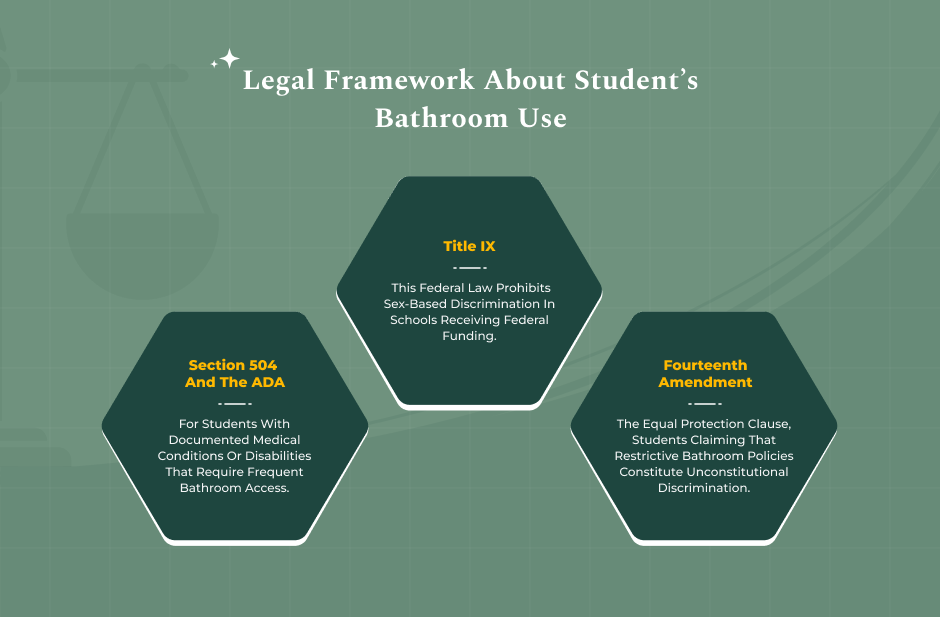
Based on the Fourteenth Amendment, students have the right to the freedom of “bodily integrity.” In asking if it is illegal not to allow a student to use the restroom, you have to determine if failing to do so “shocks the conscience” of the judiciary.
Federal Civil Rights Acts
Title IX and the Civil Rights Act make sure that there is no discrimination and that everyone has an equal opportunity to have a safe and healthy environment to learn.
General School Policies & Practices
A common tool used in most schools to track where students are also known as restroom passes. These systems are generally acceptable in courts, but they may become issues when they are used during a real emergency to ban access.
Denial Of Restroom Pass: Is It Illegal To Not Let A Student Go To The Bathroom?
So, is it illegal to not let a student go to the bathroom and deny them a restroom pass?
In the case that a student is denied access to the bathroom by the school, this can be illegal if the subsequent effect results in medical issues to the child and the action can be classed as child abuse or the violation of federal civil rights under the ADA or Section 504.
To explore why an uninformed student may not fully understand the legality behind a student not being permitted to access the bathroom, the following two legal acts regarding a student’s need to attend the bathroom must be examined.
Americans With Disabilities Act (ADA)
The Americans with Disabilities Act is a law that gives people with disabilities the same rights as all other citizens. Under a school environment, this applies in that the school is mandated to make “reasonable modifications” to their policies in order for a child with a disability to succeed.
If the child has a physical or mental impairment that impacts bladder and bowel control, the school can’t blindly send back the child when asked to go to the restroom on the mere basis of a classroom rule.
It can be considered discriminatory denial of access when the child is denied a pass under the ADA guidelines (ADA.gov).
Section 504 Of The Rehabilitation Act Of 1973
Section 504 of the Rehabilitation Act of 1973 is a federal statute that prohibits schools from discriminating against students with disabilities. This statute affects all schools that receive federal funding, encompassing all public and charter schools.
Under Section 504, the student with a medical condition such as Crohn’s disease, diabetes, and in some cases anxiety, is eligible for a document referred to as a 504 Plan. The document is a legal agreement that may include the statement the student has “unrestricted bathroom access.”
A teacher who disregards such a document and refuses a student a pass to the bathroom would violate federal law (U.S. Department of Education). This is the main reason why it is unlawful to deny a student bathroom access when a medical condition exists.
RM Passing Systems & Tracking Systems
Electronic hall passes are increasingly used in 2025 as a way to reduce vandalism and vaping. Yet if the program provides a situation where the student cannot locate an available restroom, the school may be liable.
Restroom Use Restrictions
Some educators set a limit on how many excused occasions a student can have to leave their class in one semester. If a student is turned down after having reached his limit in a case like an emergency, issues on whether it is illegal to deny a student access to the toilet become prominent.
The practice of denying a toilet break as a form of punishment is not encouraged by legal professionals and is even regarded as a sort of corporal punishment.
When Denying Bathroom Access Becomes A Legal Issue
To withhold a toilet break becomes illegal when it causes bodily harm or violation of a student’s civil rights. Schools must not forget to formulate policies that would not negate the welfare of a child in favor of disciplinary policies in schools.
Physical & Emotional Damage
If the medical condition of the child becomes a serious issue due to the use of the word “no,” the school can be sued for negligence on the part of the school.
If the child has to defecate himself due to the school’s instruction, it can be seen as a loss of dignity as a human being (U.S. Department of Education).
Is It Illegal To Not Let A Student Go To The Bathroom? Case Law And Precedents
In certain instances, like those involving the San Diego Unified School District, courts allow lawsuits for trauma inflicted on students through restrictive policies. These instances can be used to determine when it is unlawful not to allow the pupil to use the restroom.
Tort Claims And Negligence
• Injuries to the body or health.
• Severe humiliation, great emotional pain.
• A hostile education environment is created every day.
• Breach of Fourteenth Amendment provisions.
A parent’s claim against a school may entail “intentional infliction of emotional distress” where the school administrator’s refusal is determined to be so extreme as to be ‘‘malicious
Handling Special Situations: Disability, Illness, Or Pregnancy
Chronic Medical Conditions are not to be taken lightly. Conditions such as Crohn’s disease, IBS, and diabetes need to have facilities readily available.
However, children with documented disabilities and medical conditions have much stronger rights. In their case, the answer to the question of whether or not it is illegal to fail to permit the child to use the bathroom would be almost always yes.
Section 504 and ADA Compliance Its Importance
The Americans with Disabilities Act requires schools to make accommodations for children with physical or mental disabilities (ADA.gov). So, under these provisions, “Is It Illegal To Not Let A Student Go To The Bathroom?”- the question is best answered with a “Yes”. These accommodations may also include being excused to use the restroom as often as they wish at any time.
IEP & 504 Plan Rights
For instance, if there is a 504 Plan or an Individual Education Plan (IEP) that specifically requires a child to have unlimited access to the restroom facility. Failure to do this constitutes an act of defiance of the federal laws.
Best Practices For Schools And Educators
In order to sidestep the question of is it illegal to not let a student go to the bathroom, a school can adopt malleable policies regarding the issue. Teaching staff members about emergency techniques can help in preventing legal issues. Creating Inclusive Bathroom Policies
Schools must provide clean, safe, and accessible restrooms under all conditions of the school day. Policy should explicitly provide that emergencies will always be considered.
Training For Teachers On Student Health
Teachers should be able to recognize the medical consequences of denying the use of the restroom. If it is illegal to not let a student go to the bathroom should not be a matter of debate at all.
Encouraging Scheduled Breaks
If adequate time is allocated between particular classes, this will help minimize the students who leave during instructional hours.
What Parents And Students Can Do

Besides making informed decisions regarding If the rights of the child are denied, the parents must act immediately to record the circumstances.
Understanding how to deal with the school board can help the situation from drifting towards a court case.
Documenting Incidents Of Denial
Record every instance in which your child has been informed that it is illegal not to allow students to go to the bathroom by a school personnel member. Record the date, name of the teacher, and explanation for not being allowed to go to the bathroom given by the teacher.
Communicating With The School Administration
Begin by conferring with the teacher, then escalate to the principal if the issue persists. If the school fails to modify its policy, it is likely that it will be necessary to make contact with the civil rights coordinator at the local school district.
Legal Consultations
Now, if your child has been injured, your local educational attorney can guide you regarding your rights as per the relevant state and federal statutes.
Frequently Asked Question (FAQs):
The management of the classroom is a concern of the school. However, the question of “is it illegal to not let a student go to the bathroom?” in order to attend school is best answered with “priorities.” Priority, on the other hand, in the education system should be human necessities and human dignity.
Some schools lock specific restrooms to discourage vandalism or vaping, but schools cannot lock restrooms in general. This is because school codes related to fire safety require that open restrooms be accessible to students during school hours. This means that if students are not allowed access to any open restroom, that school may be in violation of laws related to health and safety standards.
If it is a legitimate emergency situation, the student would be responsible for letting the teacher know they are leaving for a medical reason. While the school district may try to discipline the student for “defiance,” it is likely that the majority of lawyers feel that it is improper discipline of the student for preventing a medical emergency.
Most states in the United States do not have a “bathroom law” for students; however, there is a general educational law for students regarding their safety and welfare. Moreover, most states have passed the “Menstrual Equity for All Act,” which is a law to provide menstrual products.