A prima facie case is the “starting line” for any serious legal fight in the American court system. It is a gatekeeper that ensures only those claims that have enough evidence to begin a trial will continue.
Today, in the early part of 2026, legal observers are following a number of prominent cases of employment discrimination in which the ability to prove a prima facie case has allowed the case to survive early motions to dismiss (Forbes).
For example, recent decisions in the tech industry have raised the bar for what constitutes initial evidence in telecommuting cases. If the plaintiff does not meet this bar, it leads to dismissal.
In this article, we will elaborate on the following:
- The core definition and historical origins of the term.
- The specific legal elements required to build a valid claim.
- How does this standard differ from other legal burdens of proof?
- Real-world examples in both civil and criminal law.
What A Prima Facie Case Means
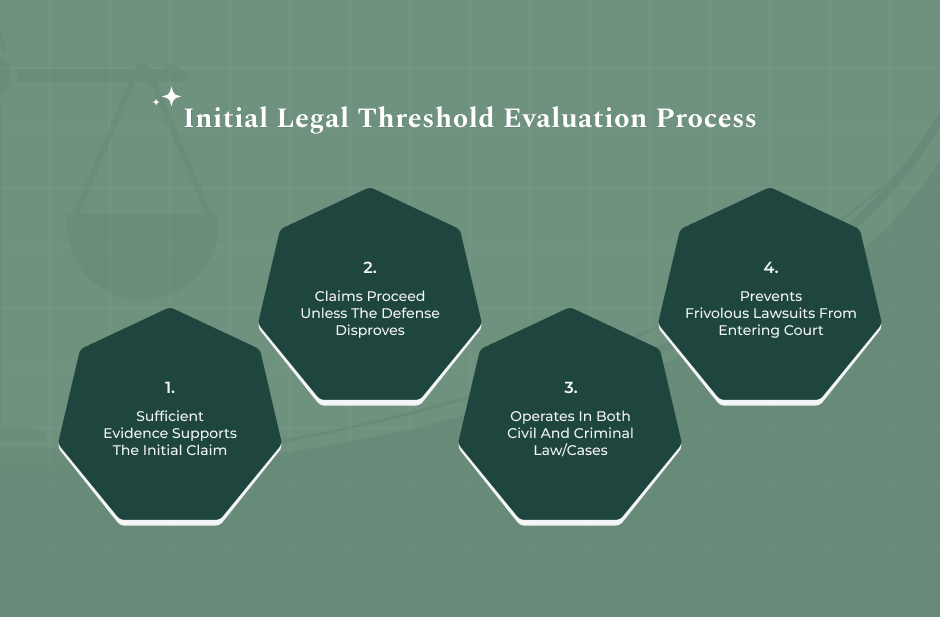
A prima facie case is a condition where one party has enough evidence to prove a legal claim until the other party offers a good contradictory argument. This is basically asking whether the facts, at first glance, indicate a violation of a law or a right.
In both civil and criminal courts, this standard is a filter for the judge in the courtroom. It keeps frivolous lawsuits from wasting time in court while also protecting lawsuits that have merit. (Source: FindLaw)
Legal Origins And Concept
The prima facie case has ancient origins that date back to the earliest forms of law. It is based on the notion that the law should not act unless there is a clear reason to do so.
This concept guarantees that the burden of proof is on the party making the claim. Without this, the law would not be able to function in an orderly and fair manner.
Latin Roots & Common Law Roots
The Latin expression “prima facie” means “on its face.” The English common law system uses this to describe the amount of evidence necessary to prove a presumption of fact.
Function In Modern Law
In today’s courts, the prima facie case definition is employed in administrative proceedings and federal litigation.
There could be a slight variation in the application of the “at first sight” rule depending on the jurisdiction, but the same principle is at play across the United States. (Black’s Law Dictionary).
Components / Elements Of A Prima Facie Case
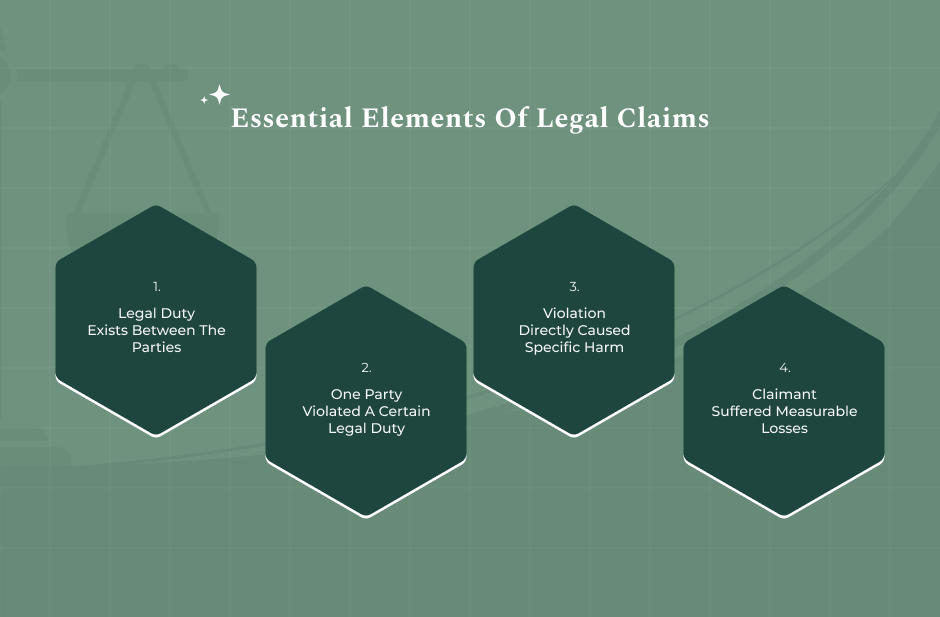
In order to make a prima facie case, the plaintiff must prove a variety of specific elements. These elements are the “building blocks” of a case, and without one, the entire case fails.
A plaintiff only has to prove their case beyond a reasonable doubt. Thus, each of these elements has to be true.
Duty / Obligation
The plaintiff’s duty is to show to the court that the defendant had a legal obligation to them. (For ex: All drivers should follow traffic laws and drive in a safe manner to protect other road users.)
Breach / Violation
The plaintiff must then prove that the defendant breached this duty. This can be achieved through an act, such as running a red light, or through an omission, such as failing to repair a dangerous sidewalk on your property.
Causation
There must be a direct link between the breach of the duty and the injury that occurred. The plaintiff must prove that the injury would not have occurred if the defendant had fulfilled their legal duty.
Damages / Harm
Finally, the plaintiff must prove actual harm. This could include medical bills, lost wages, or property damage. Without actual harm, the court will not hear the case.
Prima Facie Vs Other Legal Standards
It is simple to mistake a prima facie case for another legal term. However, they have different purposes. This legal standard is particularly concerned with the “minimum” amount of evidence required to keep a case alive.
The level of proof helps a litigant prepare the right amount of evidence for each level. This can result in an early loss if the level is misjudged.
Prima Facie Vs Probable Cause
Probable cause is the standard for arrests and searches during an investigation. A prima facie case is a more difficult standard since it requires sufficient evidence to win a trial if the opposing party does not say anything.
Prima Facie Vs Preponderance Of Evidence
In civil trials, the “preponderance of evidence” is the final standard required to win. A prima facie case is simply the first standard. You may meet this standard but still lose the trial if the defense has a better explanation.
Civil Vs Criminal Application
In a criminal prima facie case, the prosecution must show evidence for each element of the crime. In civil trials, the standard is often lower and focuses on the balance of responsibility between the litigants.
How Courts Assess A Prima Facie Case
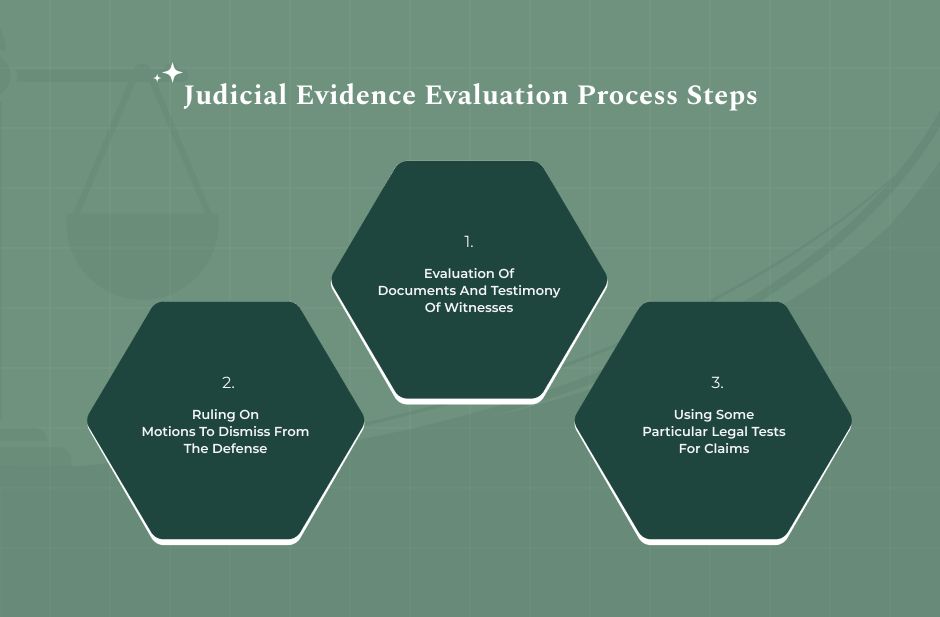
Courts apply a particular criterion to determine what constitutes a prima facie case in their court. They do not seek the “truth” in this preliminary assessment but rather examine the evidence for its legal sufficiency to proceed to trial.
This assessment takes place during pre-trial motions. If the evidence is deemed insufficient, the judge will grant a summary judgment or dismiss the case altogether.
Evidence Assessment
Courts assess valid evidence such as signed documents, testimony, and expert opinions. Even at this preliminary level, the evidence must be credible and pertinent to the particular legal issue at issue.
Procedural Assessment
The defendant typically files a motion for dismissal on the basis that the plaintiff has failed to prove the necessary elements. The judge is then required to assess whether the plaintiff has presented enough “prima facie evidence” to justify a full trial (American Bar Association).
Legal Tests & Parameters
There are particular multi-step tests that apply according to the nature of the law. For instance, in employment disputes, the McDonnell Douglas test is used to establish whether a plaintiff has satisfied the criteria for a discrimination claim.
Examples Of Prima Facie Cases
An example of a prima facie case will illustrate how these rules work. These examples illustrate how each element comes together to form a good legal claim.
Regardless of whether the case is for a contract or a physical injury, the principles are the same. The plaintiff must prove to the court that “something occurred” that the court must resolve.
Civil Law Examples
In a breach of contract case, the plaintiff proves a legal contract and that the other party failed to pay. This establishes a prima facie case for the debt. In a slip-and-fall case, proof of a wet floor and the absence of warning signs satisfies the requirement.
Criminal Law Examples
In a theft case, the prosecution shows a video of a person stealing an item without paying for it. This evidence establishes the case. The defendant may later claim they were given permission to take the item, but the prosecution has fulfilled the first obligation.
Exceptions And Limitations
Even if you believe that you have a good prima facie case, there are many ways in which it can go wrong. The legal system provides many defenses that can halt a claim in its tracks.
A claimant must be aware of these obstacles before they bring a lawsuit. In some cases, the evidence may be too weak to withstand the first level of judicial review.
Insufficient Evidence
If the evidence is based solely on rumors and conjecture, then the court will rule that no prima facie case exists. Credibility is important. If a witness has a history of dishonesty, then their testimony may not be sufficient to get past the barrier.
Legal Defenses Overcoming Prima Facie Case
The defense can offer “rebuttal evidence” to refute the claim right away. They can also rely on legal safeguards such as the statute of limitations, which holds that the claim was filed too late to be considered valid.
Expert Tips & Best Practices
To succeed in a prima facie case, you must be organized and proactive. To wait until trial time to organize your best evidence is to invite defeat.
The majority of cases are won or lost during the preparation stage. Follow these tips to ensure your case passes the first judicial review.
- Organize Documents Early: Save all receipts, emails, and contracts connected to your case.
- Understand Your Jurisdiction: Investigate how your jurisdiction views the elements of your case.
- Evaluate Credibility: Be truthful about the flaws in your witnesses before the other side brings them up.
- Seek Counsel: An attorney can assist in determining what the prima facie case requirements are for your state.
Frequently Asked Questions (FAQs):
It is not unusual for people to feel frustrated when they hear legal jargon being used in court. These FAQs will address the top three issues that U.S. citizens face when trying to understand what prima facie case logic is and how it affects them.
Understanding the burden of proof can help you decide whether or not a lawsuit is worth your time and money. Below are three important issues that will be addressed for your benefit.
If the judge finds that the plaintiff has not established the prima facie case, they will most likely grant a motion for a directed verdict or a motion to dismiss.
This means that the case will be finished at this point, and the defendant will win without having to present their case. This is a total win for the defense and can be very costly for the plaintiff who brought the lawsuit.
No, it is not. To satisfy this requirement is only to say that you have the right to go to trial. The defense still has the chance to introduce its own evidence and witnesses.
The prima facie case establishes a presumption of truth, but this presumption can be utterly invalidated in the latter stages of the trial if the defense has a better story.
Yes, it can. If the defense discovers new evidence that completely contradicts one of the required elements, they can submit a motion for summary judgment even after the case has started.
The plaintiff can also discover new documents that prove their original claim, making it hard for the defense to obtain the dismissal of the case.