VAWA immigration requirements provide those who have been beaten with legal residency in the United States, independent of their abusive family relation in the United States, whether as a United States citizen or permanent resident.
The VAWA provision is enacted under the Violence Against Women Act and provides these individuals with a ray of hope in very abusive domestic relations with United States citizens or permanent residents.
What you’ll be learning in this article:
- VAWA immigration requirements provide a confidential legal path.
- Self-petitioners must prove a qualifying family relationship.
- Applicants must document battery or extreme cruelty.
- The process helps victims escape the abuser’s control safely.
- Approved petitions lead to work permits and residency.
What Is Vawa? Law, Purpose, And Who It Helps
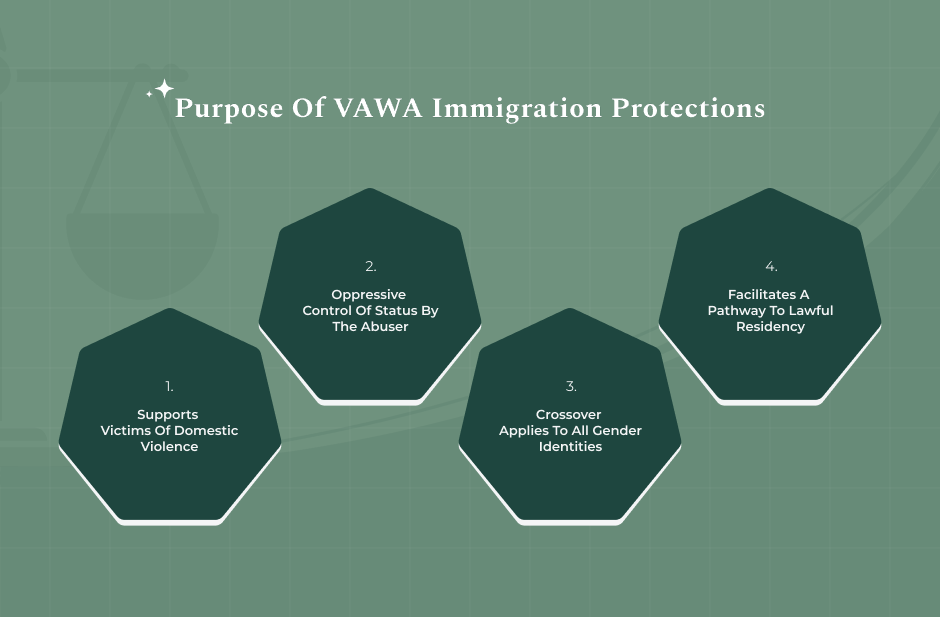
The Violence Against Women Act (VAWA) is a historic federal law that is intended to support victims of domestic violence.
Notice that the law is titled the Violence Against Women Act. Still, it is necessary to be aware that this is actually VAWA Immigration, which is not gender-specific and covers both men, women, and those of other genders.
Purpose For The Self-Petition
Both the immigration and the crime laws now permit victims to ‘self-petition’ for a green card, so that the abuser cannot use immigration status as a “tool of intimidation or control,” as stated by USCIS.
Through this removal of the abuser in the application process, the victim now holds the power to control their future.
Legal Frameworks
Since its enactment, the immigration law for VAWA has expanded over the years to include several family structures and is a foundation of humanitarian relief in the U.S.
Who Is Eligible? Qualifying Relationships & VAWA Immigration Requirements
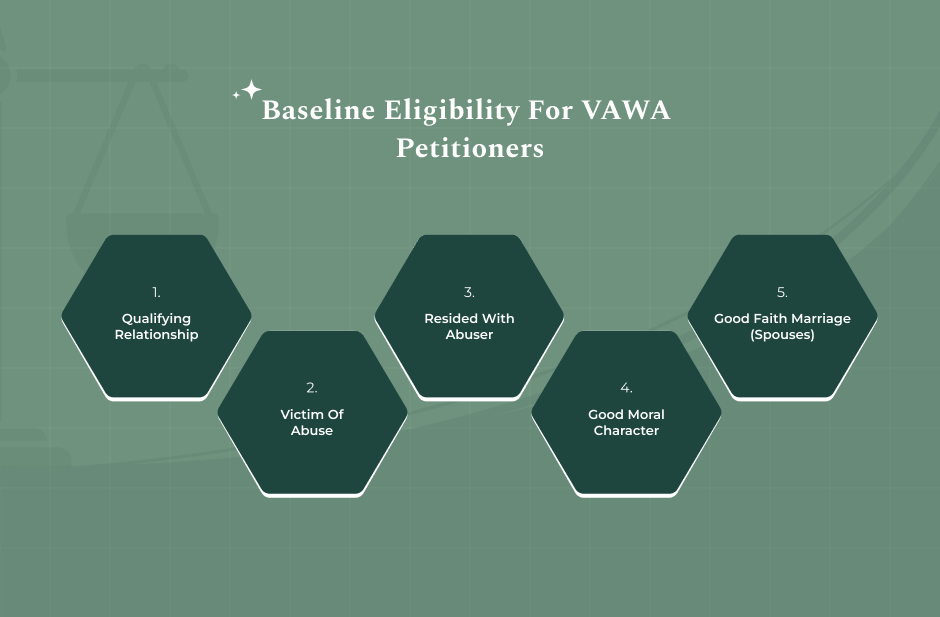
Satisfying the VAWA visa requirements begins with the submission of a specific family relationship with a U.S. Citizen (USC) or a Lawful Permanent Resident (LPR).
Qualifying Relationship- Spouse, Parent, Child
You may file for a VAWA visa if you are the abused spouse of a USC or LPR, or the abused parent of a U.S. child.
Moreover, the parents of abused USC children and children of abused USC/LPR parents also qualify.
Former spouses can also apply if the marriage was dissolved due to abuse within the previous two years.
Abuse- Types And Credible Evidence
Battery or extreme cruelty is what USCIS is looking for. It could be physical injuries, but it could also be mental or physical abuse, confinement, and even deportation threats.
“Any credible evidence” is what the court will base its decision on, even if there is no police report (USCIS).
Other Eligibility Criteria
You must prove that you have been living with the abuser and that you are now living in the United States (except in certain cases for government employees).
In addition to this requirement, good moral character, usually demonstrated through having no record of crime and through affidavits of character, must also be demonstrated.
Applying – A Step-by-Step Filing Procedure – VAWA Immigration Requirements
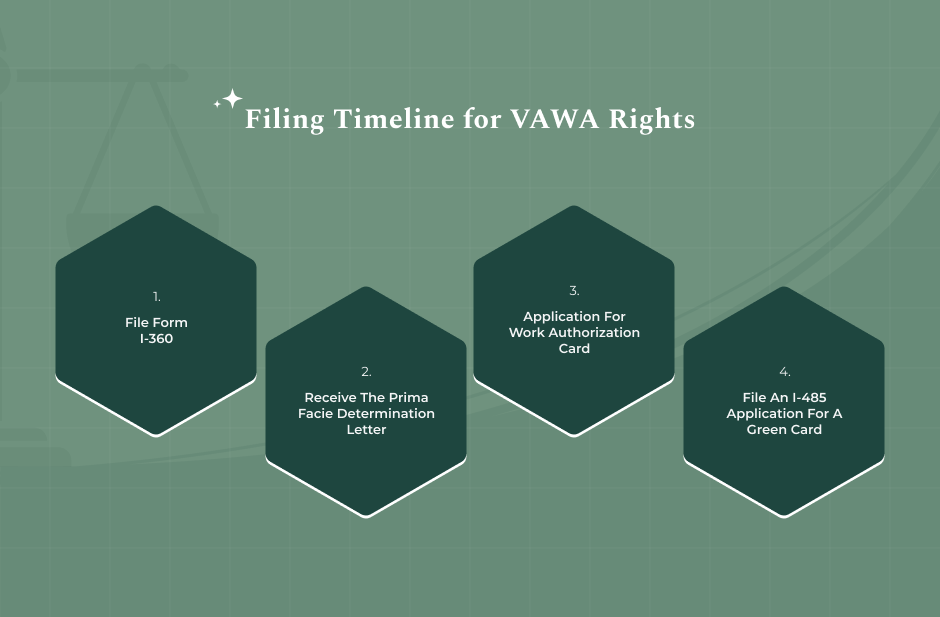
There are various steps involved in applying for immigration under the immigration provisions of the VAWA.
Step 1 – Filing Form I-360
The process starts with Form I-360. This is basically the first form where you demonstrate your eligibility.
It is very important to ensure you have a safe address where your mail is not accessible to the abuser.
Step 2 – Adjustment of Status (I-485)
Once your I-360 is approved (or simultaneously submitted in certain circumstances), you may apply for a Green Card through Form I-485.
This will depend upon whether your abuser is a citizen or a Green card holder, as there is a distinction regarding “priority dates” for the latter.
Step 3 – Work and Travel Authorization
While awaiting the disposition of your case, you may apply for an Employment Authorization Document, or EAD.
This permits you to work in the United States while awaiting the disposition of your residency application, which is filed through USCIS.
VAWA Immigration Requirements Evidence Checklist

In satisfying the VAWA visa requirements, your evidence must be well-organized and persuasive.
You should obtain marriage certificates or birth certificates in order to establish a relationship. As concerns the battery, police reports, as well as pictures of injuries, should be obtained.
In case you lack these, there is no alternative but to make “witness affidavits” from friends, clergymen, or therapists. The most significant evidence may be your written testimony about what took place.
Common Scams and How to Protect Yourself

Vulnerable individuals may become prey for ‘notarios’ and unauthorized legal consultants. To safeguard your case, you must hire an accredited VAWA immigration attorney or an accredited representative from the U.S. Department of Justice.
Red Flags
But beware of anyone trying to “guarantee” a green card or asking you to sign a blank form.
Inconsistent explanations or a lack of facts on “good faith” marriage can also result in a denial of a case.
Double-check if the attorney has a license through the State Bar website before engaging their services.
VAWA vs Other Options (U Visa, T Visa, Asylum)
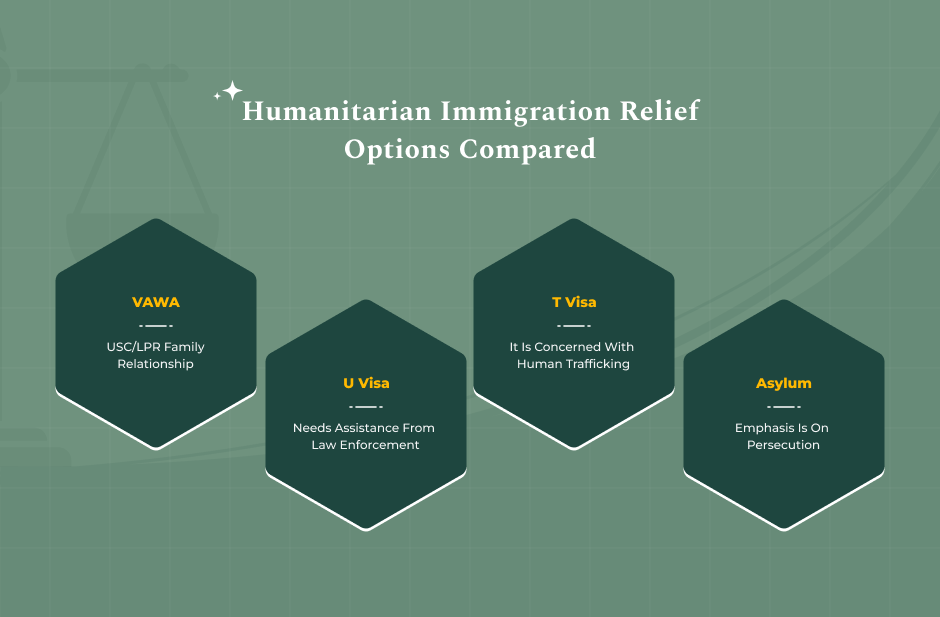
Also, there might be instances where an applicant qualifies under the VAWA immigration requirements yet finds that there is a better applicable immigration status, which could be U Visa (crime victims) or a T Visa (trafficking victims).
The VAWA process is faster than the U Visa process, which has a huge backlog and a cap of 10,000 visas per year.
However, if you were not married to your abuser and they do not have status in the US or a visa, a U visa may be your only option.
The best advice on such alternatives is to speak with a specialist immigration professional.
Read Also: Alien Registration Number: What Is It And How To Get It?
Expert Tips And Safety Information
Your safety is always the primary concern within the context of the VAWA immigration requirements.
Make sure to always send mail to and receive mail from USCIS at a “safe address” or P.O. Box.
Avoid updating your social media regarding your case, given that your abusers could potentially use this information against you.
In a case where there is imminent danger, call The National Domestic Violence Hotline at 800-799-7233. There exist several NGOs willing to assist at no fee if one cannot afford a lawyer.
VAWA Immigration Requirements – Frequently Asked Questions (FAQs):
What are the basic immigration requirements under VAWA? You are required to show that you have a qualifying relationship with a U.S. national or LPR abuser, that you lived together, that it is a marriage of good faith, and that you were subjected to battery or extreme cruelty. You must demonstrate you are of good moral character.
You will need to complete and submit Form I-360, Petition for Amerasian, Widow(er), or Special Immigrant. The application is free of charge when based on a VAWA application (USC
No. Strict confidentiality laws prescribe the sharing of the fact that you have applied for VAWA by USCIS. They will not ask the abuser for information regarding your case (USCIS).
Yes. The act is gender-neutral. Abused husbands and spouses in same-sex relations in legal marriages are eligible for the act if the rest of the VAWA criteria apply to them (American Immigration Council).
But you are still eligible to apply for VAWA. In most situations, the filing of a prima facie eligible petition can also stay removal while the case is being determined.
Find attorneys via the American Immigration Lawyers Association (AILA) or search for non-profits identified by the Department of Justice (DOJ) that work with survivors of violence (NIJC).
The decision to move out of the abusive situation and go for the VAWA immigration requirements is one of the bravest decisions that a person can ever make.
With the right steps and evidence, you can look forward to living a life of safety and not fear.