Emigration vs immigration is a pair of terms that define exactly the same process of human movement, with the point of geographical focus being exactly opposite in each case.
Although we would normally use these two terms interchangeably in a common context and even in official discourse, they represent something significant in their respective contexts.
Thus, they apply differently in different situations regarding the regulation of international frontiers and the control of the economy of a country.
Here’s what you will come across in this article:
- Directional Focus: The emphasis on immigration is on entering the country, while emigration is on leaving it.
- Perspective: You move from being an immigrant to your destination and simultaneously emigrate from your origin.
- Legal Frameworks: Countries apply varying visa regulations and laws controlling these movements.
- Economic Impact: Both of these factors influence global remittances and the labor market.
Core Concepts: Immigration, Emigration & Related Terms
To grasp the complexities that lie within the differences between immigration and emigration, it is necessary that the intrinsic definitions adhered to by global organizations are set forth first and foremost.
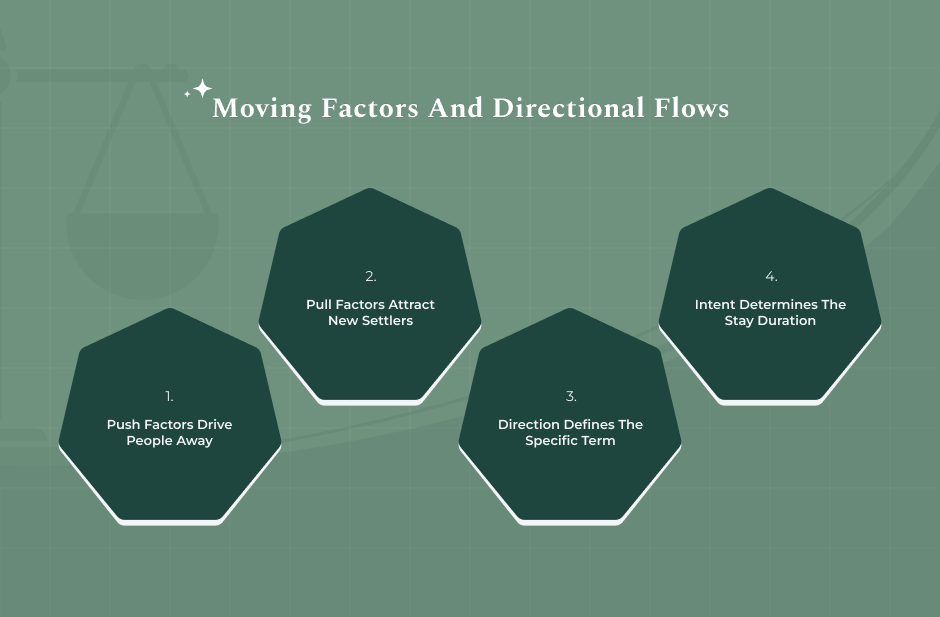
The directional perspective is the factor that influences which particular terminology is going to be utilized within a certain individual’s context.
Emigration vs Immigration: Defining And Direction Finding
The emigration vs immigration definition is based solely on the point of origin and destination.
Immigration is defined as the act of entering and settling in a foreign country with the intention of living there permanently or for a long time.
Meanwhile, the emigration vs immigration definition is defined as ‘the act of permanently leaving one’s resident country to settle in another country.
Essentially, all individuals who participate in international mobility qualify as ‘migrants.’ However, depending on which side of the arrival and departure terminals you find yourself, your identity is determined by immigration or emigration.
Push & Pull Factors
People migrate because of a push and a pull. The push can be a factor of a person’s home country, such as:
- Lack of jobs.
- Lack of political stability.
- Natural disaster.
Pull may relate to:
- Better pay.
- Better education opportunities.
- Reunification.
In discussing migration, immigration, and emigration, these terms explain why people migrate.
Immigration vs Emigration: Point-to-Point Comparison
In a comparison between immigration and emigration, one must examine the official, psychological, and economic components.
For the individual, the official statistics surrounding both situations will serve two different sets of national interests.
Administrative And Legal Frameworks
These countries would target immigration quotas, work visas, and citizenship requirements to control who enters their territories.
On the other hand, the country of origin may have regulations or policies aimed at supporting its citizens outside the country or exiting the country.
These policies include exit visas, among others, that may safeguard their workers from exploitation outside the country.
Statistical Analysis: Statistical Metrics And Measurement
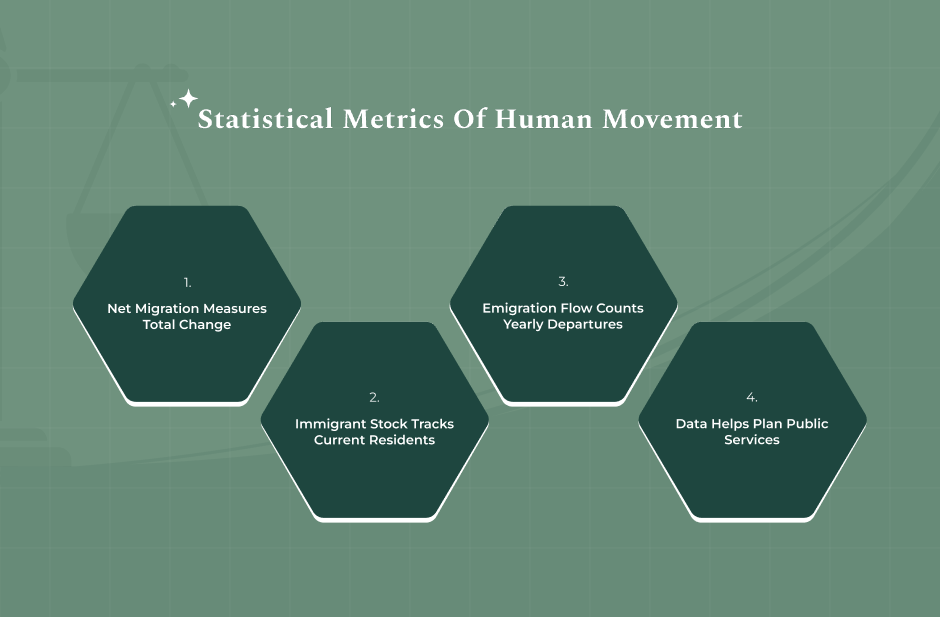
“Immigrant stock” is tracked as the population of foreign-born residents in a given country.
“Emigration flow” measures the outflow of people each year. The difference between the two values is calculated as “net migration.”
Net migration is a positive value when the influx exceeds the outflow. It usually applies to developed countries with higher incomes.
Legal Policy, Institutional Frameworks & Global Trends And Data In 2025
The current scenario of immigration, as opposed to emigration, has changed dramatically over the past years owing to the rise of digital nomadism and climate change.
The current statistics from the International Organization of Migration reveal that international migrants comprise 3.6% of the world’s population.
Global Trends And Case Examples
At present, India is leading in terms of the number of emigrants, with a huge diaspora population distributed in Gulf nations, North America, and European countries.
Similarly, the United States is leading in terms of hosting immigrant populations in foreign nations.
Interestingly, there is an increase in “return migration,” in which people return to their nations of origin after spending considerable time abroad, bringing fresh experiences and capital.
Policies & Framework
The issue of immigration and emigration is treated by states with varying degrees of legal intensity.
Though a lot of Western countries concentrate more on who is admitted into their territories and so forth, other countries are more concerned about who is leaving and for what reasons.
Exits And Emigration Controls
In fact, laws governing the departing population include the Emigration Act of 1983 in the Indian government. Its intention is to safeguard less-skilled immigrants departing for other areas.
Conversely, laws governing immigration tend to be intricate, using the point system to choose immigrants in countries such as Canada and Australia.
Case Studies: India And The United States
To better illustrate the concept of immigration vs. emigration, we may consider the connection between the main hubs of origin and reception of migration movements.
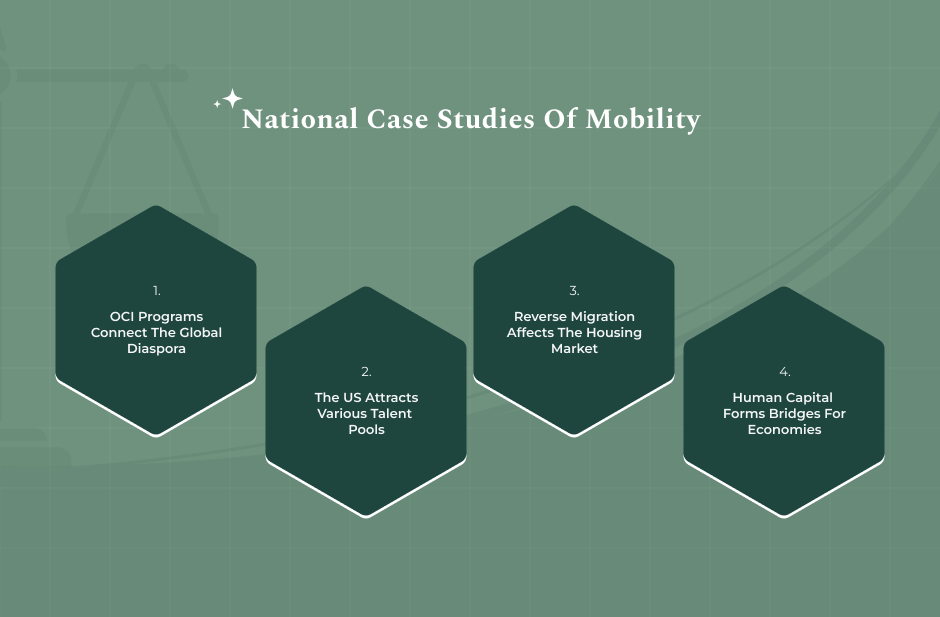
Such interactions give rise to a global “brain circulation” rather than the usual “brain drain.”
India – The Origin Powerhouse
India’s emigration trend varies, from skilled tech engineers in Silicon Valley to Indian construction workers in the UAE.
The Indian government remains active within the diaspora communities, having initiated a program called “Overseas Citizenship of India.” Here, overseas Indian citizens are encouraged to invest and visit India.
The above example indicates how a state can make emigration a source of strength.
The United States As A Destination Hub
America is still the chief destination for those looking for a fresh start.
Nevertheless, there is also an emergent pattern of Americans settling in other nations, such as Portugal or Mexico, where living expenses are lower and where work-life balance is better.
This “reverse flow” migrant pattern illustrates that even where there is considerable immigration, there is also significant emigration.
Read Also: L1b Visa Requirements And Strategy Guide
Measurement And Methodological Issues
The measurement of immigration versus emigration is incredibly hard as there are porous borders. Many of the articles fail to consider that immigration/emigration is only estimated.
The term “long-term” also has a variety of definitions from one country to another.
In some cases, if a person resided there for over six months, he or she could be considered a long-term resident.
In others, if a resident stayed for over a year, they could be referred to as a long-term resident.
On the other hand, irregular migration makes it difficult to obtain a precise figure regarding emigration flows.
New approaches are now being developed by academics, and estimates are being made using digital footprints and name-based detection of nationality.
Economic And Social Impacts
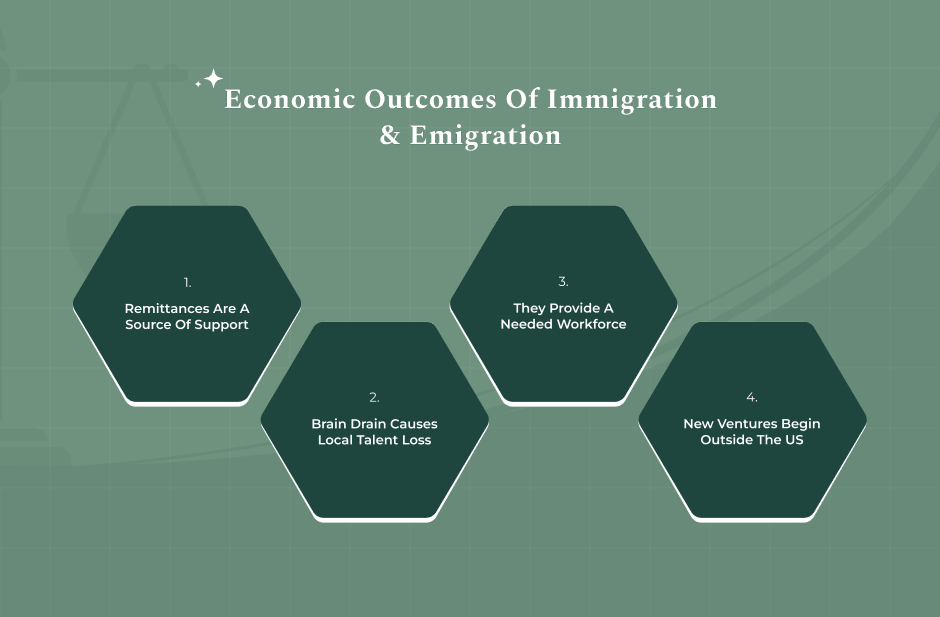
The immigration versus emigration discussion is commonly based on money and culture.
There is a significant impact on both the country of origin and the country of destination when immigration or emigration occurs.
Remittances And Brain Drain
Emigration is also sometimes responsible for the phenomenon that is referred to as the ‘brain drain,’ which means that the best-educated people from a particular country move out.
Despite this loss, the amount that is referred to as ‘remittances’ from such countries is estimated at billions of dollars and may contribute largely to the GDP of the home country.
Once an immigrant moves to a foreign country, he or she helps bridge gaps such as healthcare, farming, and information technology.
Expert Tips For Choosing The Right Term
While writing or researching, depending on the context, whether it is immigration or emigration, is subject to interpretation. Your audience could get confused if you refer to it in the wrong context.
1. Check The Direction
If the focus is on the number of people entering a country, the word to use is immigration. If the focus is on the number of people leaving the country, the word to use is emigration
2. Source Identification
It is essential to source every year cited. The data for 2020 is very different compared to the data in 2025, considering the impacts caused by the pandemic.
3. Avoiding Bias
You may want to employ the non-biased term ‘migrant’ or ‘mobile population’ when the directional component is not a significant element of your argument.
Read Also: What Is Visa Provisioning Service? Complete Guide To Card Security
Frequently Asked Questions (FAQs):
In closing, the topic of immigration versus emigration relates to the world we live in today as a global community. Regardless of whether it has to do with the financial aspect of remittances or the legal repercussions of the Visa limit, immigration and emigration affect us.
Through knowledge of the terminology and the statistics that come along with it, we are able to engage in a well-informed discussion on the future of immigration.
The reason for the difference is the point of view. Migration means moving from one country to another. Emigration means leaving your own country. So, if you move from Italy to Britain, you will be an emigrant from Italy and an immigrant in Britain.
Yes, both. Everyone who moves across international borders is both. You are an emigrant in the country you left, and an immigrant in the country where you now live.
The term, of course, depends on which country you happen to be thinking of at the time.
People leave their countries due to numerous push and pull factors. Push factors may include:
• Looking for higher-paying employment.
• Escaping war and political repression.
• Joining relatives.
It can also include providing improved educational facilities for their offspring.