It is very important for travelers and expats to know the difference between consulate vs embassy. It ensures that they can approach the right office in case of emergencies or when they need help with administrative work.
But why should you learn about the difference between these two?
Here are some of the reasons why it is good to be aware of the differences between a consulate and an embassy:
- They differ in location and accessibility.
- They also differ in terms of emergency assistance.
Besides that, it makes one’s life easier when dealing with administrative tasks. For example:
- Embassies are responsible for the political relations between the two governments, the signing of international agreements, and visits of the heads of state.
- Consulates provide more people-oriented services. For example, they issue visas to foreigners and provide notarial services. Furthermore, they also register births and marriages of their nationals.
In this blog, we will break down the following things:
- What is an embassy?
- What is a consulate?
- Key differences between consulate vs embassy.
- Legal status and protection.
- How does it impact visa and passport services?
Therefore, if these are a few things that you want to know, keep on reading this blog till the end…
What Is An Embassy?
An embassy primarily refers to a diplomatic mission of one country in another and normally they are located in the capital city of the host nation.
Apart from that, it is the headquarters of an ambassador, the highest-ranking diplomat who usually has the role of the personal representative of the head of state of the country he or she comes from.
“An embassy is an official headquarters for U.S. diplomats and government representatives serving in a foreign country,” according to the National Museum of American Diplomacy.
Key Functions & Role Of An Embassy
Even in 2026, an embassy’s role is still clear from the Vienna Convention on Diplomatic Relations, being the essential central point of official representation of a nation in a foreign country.
According to American Diplomacy, the main role or function of the US embassy is to “assist American citizens who travel to or live in the host country.”
An embassy has a very significant role in:
- Diplomatic Relations.
- Citizen Services.
- Visa Processing.
- Policy & Promotion.
Where Can You Find An Embassy?
As the main task of an embassy is to liaise with the central government of the host country, the embassies are almost always located in the capital (e.g., New Delhi, Washington D.C., or London).
What Is A Consulate?
A consulate functions as a diplomatic office that portrays one country’s government in a foreign city.
In contrast to an embassy that is the main headquarters for top, level political and government, to, government relations (generally in the capital of the host country), a consulate is like a local branch office that helps individual citizens and businesses in the area.
Berardi Immigration Law explains a consulate as the “secondary diplomatic mission established by a country within another country’s territory.”
While embassies can be found in the capitals, consulates are generally located in large cities. Consulates are under the authority of consuls general who oversee the daily operations of these smaller offices and dedicate almost all their time to providing consular services.
Hence, they are extremely valuable for people who are dealing with immigration, travel, or legal matters.
Key Functions & Role Of A Consulate
Even today, a consulate is still an essential regional branch of a country’s diplomatic presence that primarily concentrates on individual citizen support and local economic interests within a particular “consular district.”
Consulates are the ones, unlike embassies, which take care of the politics at the very top government, to, government level, that consulate staff handle the practical, everyday requirements of the people and businesses.
Here are some of the major functions of the consulate that you should know about:
- Assisting Citizens Abroad.
- Passport and Document Services.
- Visa Processing.
- Economic & Trade Relations.
Where Can You Find A Consulate?
Unlike an embassy, which is almost always in the capital city, a consulate can generally be found in large regional cities away from a host country’s capital.
They are primarily strategically located in economic hubs or tourist centres. You can even find them in areas with a high concentration of expatriates, making it easier to provide services.
Read Also: Immigration Vs Emigration – A Comprehensive Handbook
Consulate Vs Embassy: Key Differences Explained
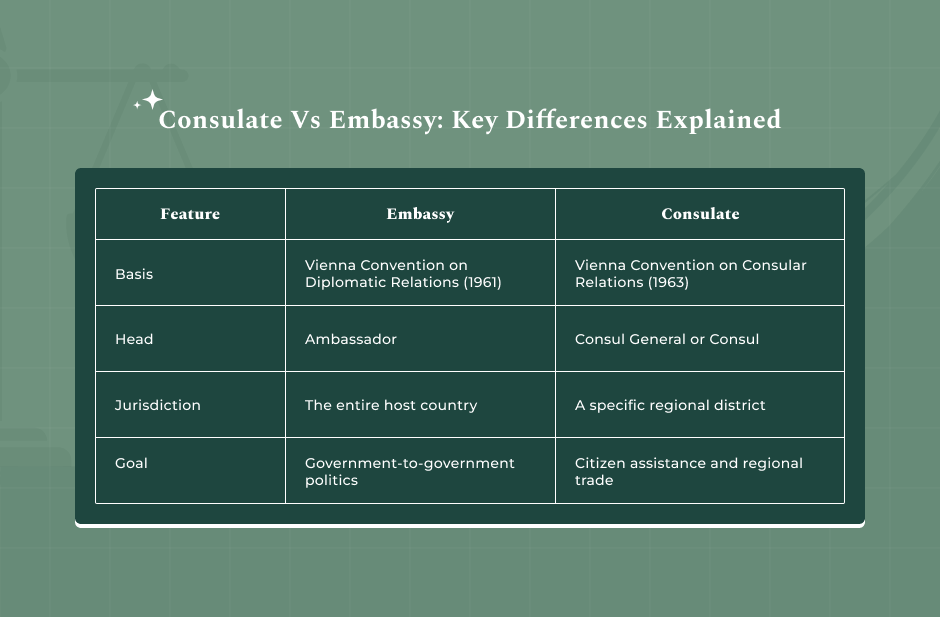
There are three key differences between embassies and consulates: location, hierarchy, and the scope of services provided.
1. Location
Embassies are situated in the capital city of the host country, usually close to government institutions and other diplomatic missions.
Consulates, however, are set up in large cities apart from the capital, and are thus able to support and provide services more effectively to the citizens and businesses living in these areas.
2. Hierarchy
The authority in an embassy is usually an ambassador, the one who represents the head of state or government of the sending country. Ambassadors have a higher diplomatic rank than consuls.
The head of a consulate, on the other hand, is normally a consul or a consul general, who holds a lower diplomatic rank than an ambassador.
3. Scope Of Services
Embassies, in the first place, deal with international relations at the highest level, political negotiations, and treaty agreements between the two national governments. They are the “big picture” representatives of a country’s foreign policy.
Consulates, conversely, are chiefly engaged in providing services to citizens and giving administrative support, like issuing visas, renewing passports, and helping nationals if they are in trouble (e.g., arrested or sick). They concentrate on local trade and create “people, to, people” links.
Consulate Vs Embassy: Diplomatic Legal Status & Protections
It is through mutual agreement that countries establish diplomatic relations, which is typically through the exchange of diplomatic notes or a joint communique.
After such an establishment, countries can talk about the possibility of opening embassies or consulates, which entails:
- Diplomatic privileges and immunities being negotiated.
- The decision on the location of the embassy or consulate premises that the host government approves.
- The construction or renovation of the diplomatic building to the level of security and functional standards.
- Appoint an ambassador or consul who must be accepted by the host country through a process called “agreement”.
- Presenting credentials to the host country’s head of state to mark the opening ceremonies.
Besides that, diplomatic missions serve major international organizations such as the United Nations.
Primarily, according to the Herman Legal Group, this underscores the importance of the UN as a platform where member countries are formally represented and engage diplomatically.
Consulate Vs Embassy: How Does This Apply To Visa & Passport Processes?
Both embassies and consulates act as representatives of their home countries overseas. However, as we have already mentioned, they each handle different roles when it comes to visa and passport matters.
Most of the time, in 2026, locals and foreigners will find consulates their first and main point of contact for these documents, while embassies will address diplomatic aspects at the highest level.
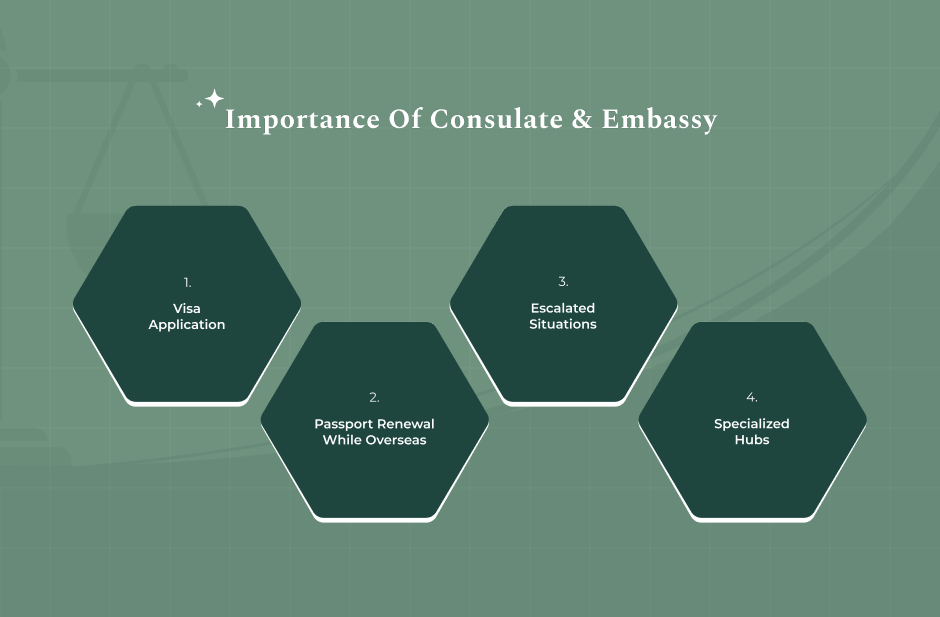
Here are a few different ways this can impact you in terms of Visa and passport services and processes:
1. Visa Application
To apply for a visa, you typically go to the consulate that is assigned to your residential area. Besides that, several nations in 2026 are relying on third-party organizations such as VFS Global to receive applications before the consulate or embassy starts the processing.
2. Passport Renewal While Overseas
If you are living abroad, the most straightforward path is to get in touch with the nearest consulate for any kind of renewal or reissue. The embassy’s consular section will take care of you if you stay in the capital.
3. Escalated Situations
It is most often the consulates that are immediately available and ready to help citizens who are losing passports or encountering legal problems in the local area.
4. Specialized Hubs
Some states designate centralized locations for specific types of visas. For instance, in 2026, certain categories of German Schengen visas are handled at the Mumbai consulate regardless of where the applicant lives.
Read Also: H1B Visa Stamping In USA – Latest Rules And Process
Is An Embassy Or Consulate Foreign Territory?
It is a popular misconception that embassies and consulates are located on foreign territory. The truth is they remain under the jurisdiction of the host country, not the sending country.
For instance, the Indian embassy located in the United States will be under the US jurisdiction and not under Indian jurisdiction.
However, what embassies and consulates do have are some special rights under international law. These include the following:
- Inviolability: Authorities of the host country cannot enter the premises without consent. This is to keep the diplomatic staff safe.
- Diplomatic Immunity: Diplomats have the right to be free from arrest, detention, and criminal charges under the local laws of the host country. Consular officers enjoy similar immunities, but only when they are performing their official duties.
- Tax Exemptions: Diplomatic and consular missions, as well as their personnel, are usually exempt from certain local taxes.
However, according to the official American Diplomacy platform, “U.S. embassies and consulates abroad, as well as foreign countries’ embassies and consulates in the United States, have a special status.”
They mention that even though for every other nation the host country/government is responsible for the “security of U.S. diplomats and the area around an embassy, the embassy itself belongs to the country it represents.”