Questions: How does a writ of habeas corpus safeguard individual freedom?
Options:
- It prevents arrest and detention.
- By providing a defense for committing a crime.
- By providing a way to avoid sentencing at trial.
- It prevents unlawful or arbitrary detention without evidence.
If your answer is option D. It prevents unlawful or arbitrary detention without evidence, then you are absolutely correct.
However, it is important to understand what the writ of habeas corpus is and how it really works in the first place.
Basically, we can say that a writ is a formal, written order from a court or a law enforcement authority. It directs a person or entity to do or not to do something.
Among the different types of writs, one of them is the Habeas Corpus. In order to get the answer to “how does a writ of habeas corpus safeguard individual freedom?”, keep on reading this article till the end…
What Is The Writ Of Habeas Corpus?
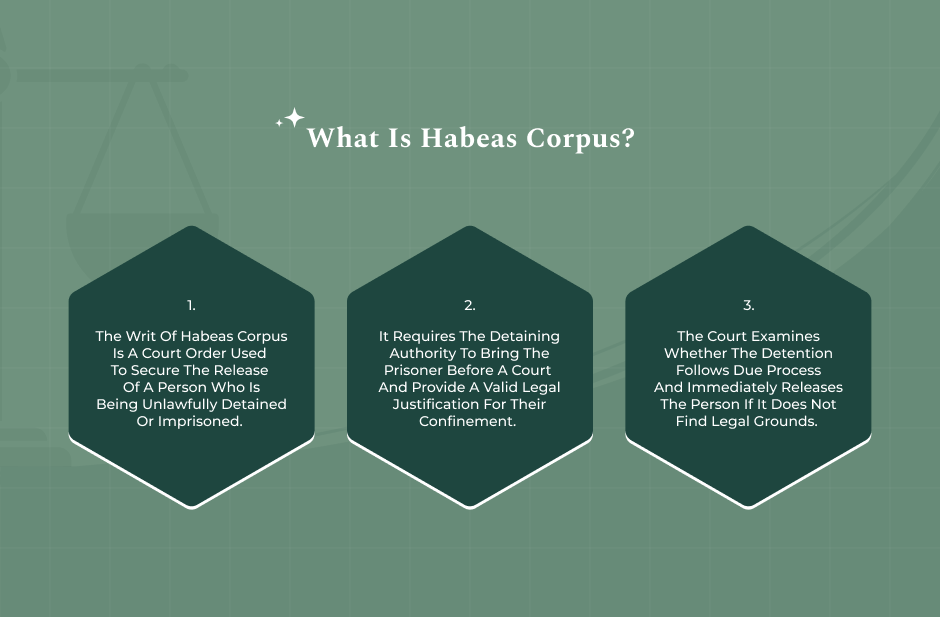
A writ of habeas corpus (Latin: “you have the body”) is a common law writ that a judge or court issues. It orders the production of a prisoner or detainee before the court for a specified purpose.
According to the US Courts, it usually is a court order requiring the police to bring a prisoner to court and explain why the prisoner has not been set free.
One of the most common and important purposes of such a writ is to check the lawfulness of a person’s:
- Arrest.
- Imprisonment.
- Detention.
Federal judges get requests from state prisoners who claim that their state trials somehow violated rights protected by federal law.
Additionally, the federal inmates can also submit habeas petitions. They may issue a habeas corpus writ to bring a detained person before the court to give evidence or to face the charges.
History & Roots Of The Writ Of Habeas Corpus
Britannica correctly mentions that it is very difficult to ascertain the exact origin of the writ of habeas corpus. Various writs used before the Magna Carta (1215) had some of the functions of habeas corpus.
Such writs were used to bring cases from lower tribunals to the king’s courts during the Middle Ages.
“The modern history of such a writ as a device for the protection of personal liberty against official authority may be said to date from the reign of Henry VII (1485–1509), when efforts were made to employ it on behalf of persons imprisoned by the Privy Council.”
By the time of Charles I, the law recognized the habeas corpus writ as the proper procedure. This prevented lower courts or public officials from unlawfully detaining someone.
The 1679 Habeas Corpus Act played an important role. It laid out many of the processes that would make asserting these rights effective.
Among other things, the Act allowed judges to issue writs even when the courts were not in session. Additionally, they could impose severe penalties on magistrates who, without a valid reason, refused to issue such writs.
The use of the writ was extended in the 19th century to cover those held under private authority.
Modern Application And Use Of The Writ Of Habeas Corpus
In different ways, writs of habeas corpus have been used in the United States in recent times. Around the 1950s and 1960s, the Supreme Court’s liberal interpretation of the constitutional rights of the accused provoked a surge in habeas corpus petitions.
And this was mainly from prison inmates who were seeking to overturn their convictions. Eventually, the Supreme Court and Congress, through legislative measures in the later decades of the century, slowly tightened this interpretation.
Nowadays, a writ of habeas corpus is most often filed on behalf of a person in police custody, directing the police to either charge the arrested individual with a crime or release the person.
Additionally, bail hearings are sometimes instituted through habeas corpus to obtain the release of an accused party before trial when the bail is considered unreasonably high.
There have been instances when prisoners got habeas corpus relief on the grounds of unlawful detention post their release dates.
One may resort to a habeas corpus petition to contest the legitimacy of a warrant issued in an extradition case.
How Does A Writ Of Habeas Corpus Safeguard Individual Freedom?
“The U.S. Supreme Court has recognized that the ‘writ of habeas corpus is the fundamental instrument for safeguarding individual freedom against arbitrary and lawless state action’,” according to the Legal Information Institute.
So, how does a writ of habeas corpus safeguard individual freedom?
Protection Against Arbitrary Detention
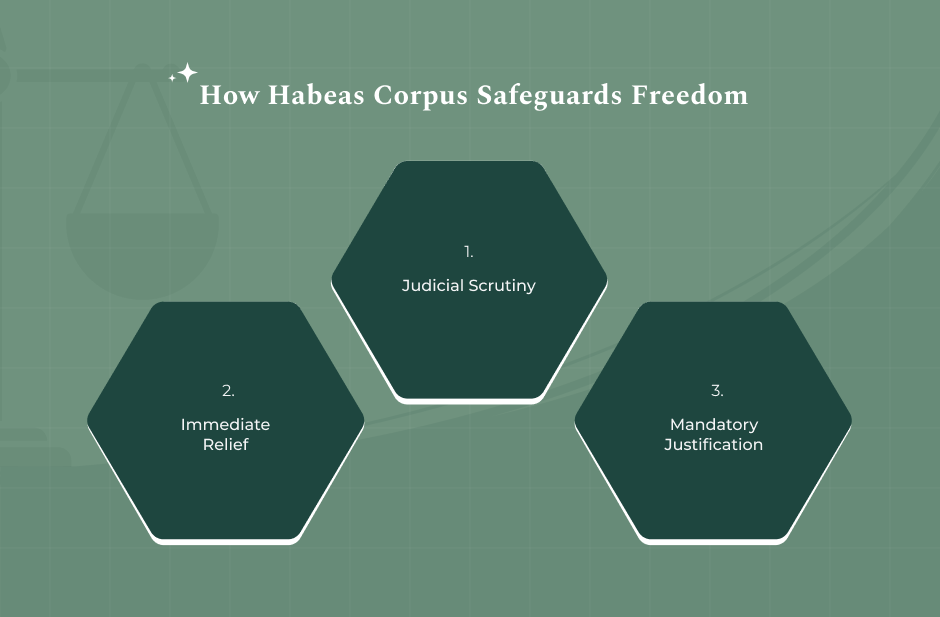
With this writ, a person is able to question their detention before a court. Consequently, it guarantees that no one can forcibly remove an individual from their residence without a court order.
Some of the major ways in which it safeguards the rights of every individual are:
- Mandatory Court Production: The court mandates the detention authority to present the person in custody before a judge.
- Judicial Scrutiny of Legality: The court reviews the legal grounds and evidence for the detention. If neither the state nor a private entity can lawfully justify the detention, the court releases the detainee.
- Check on Arbitrary Power: The writ is an indispensable procedural weapon against law enforcement misconduct. Thus, it prevents illegal arrests and keeps the state from detaining a person beyond the authorized periods.
- Speedy Redress: The remedy that the person wrongfully imprisoned would have is very fast. Therefore, you can consider the writ of habeas corpus as a “constitutional privilege” for freedom.
Due Process Of Law
Habeas corpus is a legal action that allows individuals to challenge their detention. This means that no one, including the state, can deprive an individual of liberty arbitrarily.
And that is because this writ provides a mechanism for the court to review and enforce the standard. Therefore, people often refer to this as a “writ of enquiry.” This means the courts will check whether the executive branch followed the law.
Here’s how it is tied to due process of law:
- Substantive v. Procedural: Depending on the jurisdiction, the writ of habeas corpus is a procedural remedy, not a substantive right. It does not determine whether a person is guilty or innocent. It only determines whether the procedure for detaining an individual was fair and proper.
- Prevention of Arbitrary Detentions: The requirement for the state to present just cause for a detention. In this way, it ensures that no state engages in unlawful acts.
The U.S. Constitution protects the “privilege of the writ of habeas corpus” under the Suspension Clause and that no person shall be deprived of liberty without due process of law under the Due Process Clauses (5th and 14th Amendments).
In the landmark Boumediene v. Bush (2008) case, the Supreme Court held that non-citizen detainees at Guantanamo Bay have a constitutional right to habeas corpus under the Suspension Clause.
The Court notably grounded its decision in the Suspension Clause rather than the Due Process Clause, sparking scholarly debate about how the two interrelate
How Does Habeas Corpus Work: Step-by-Step Process
Now that you know the answer to “how does a writ of habeas corpus safeguard individual freedom?” let’s move to the process.
The process of habeas corpus is an urgent legal tool to challenge the lawfulness of someone’s detention.
Although the specific regulations differ from one country to another, the step-by-step process usually makes a standard judicial journey.
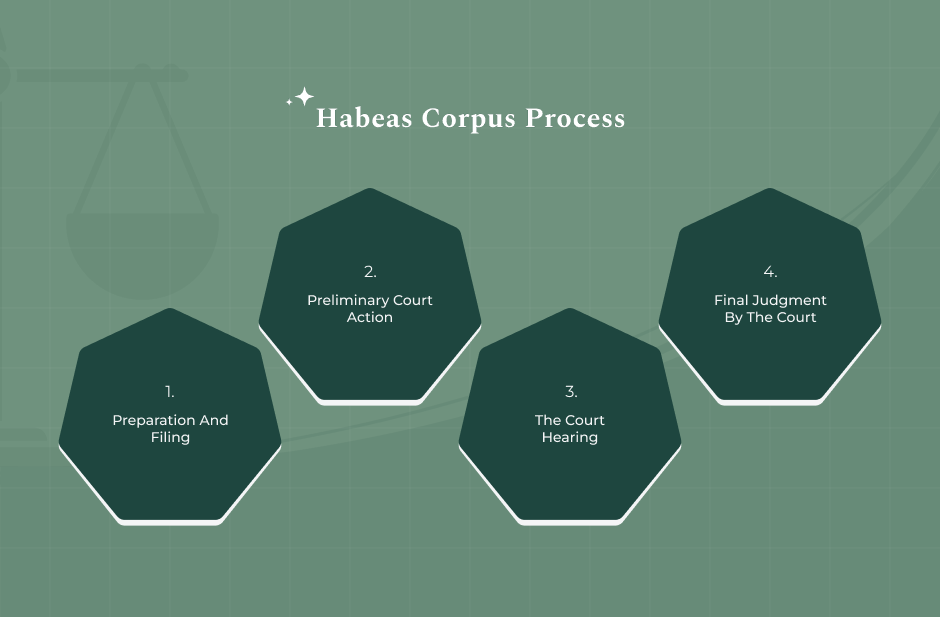
1. Preparation And Filing
Firstly, produce identification and location of the detainee. This is a formal petition for the writ. This generally mentions the following:
- Detainee’s information.
- Nature and the grounds of the detention.
- A plea seeking the instant release of the detainee.
A bench that has the authority over the subject matter initiates the petition. For example, in India, this will mostly be the High Court (under Article 226) or the Supreme Court (under Article 32).
If the detainee is kept incommunicado, any of their relatives, friends, or legal advisers may submit the petition on their behalf.
2. Preliminary Court Action
From the petition, the court decides whether there is a prima facie case of illegal detention or not.
Upon finding the case worthy, the court proceeds to issue a “Rule Nisi”—a command to the detaining authority to come before the court and “show cause” why the person should not be set free.
The court might also instruct the authority to bring the person into court physically (to “have the body”).
3. The Hearing
During the hearing, the detaining authority must justify the detention on legal grounds.
In most cases, the responsibility of proving that the detention is lawful falls on the state or the detaining authority.
The judge decides whether the detention violates the person’s constitutional rights or exceeds the legitimate time limit.
4. Final Judgment
Finally, after hearing both sides, the court pronounces its decision. If the detention is illegal, the court will order the person’s immediate release.
On the other hand, if the authority furnishes an acceptable legal justification (for example, detention ordered by a competent court in a criminal matter), the petition shall be rejected.
Key Legal Parameters & Evaluation Criteria
While it’s true that the writ of habeas corpus acts as a protector and prevents the arbitrary detention of individuals, there are certain parameters for this.
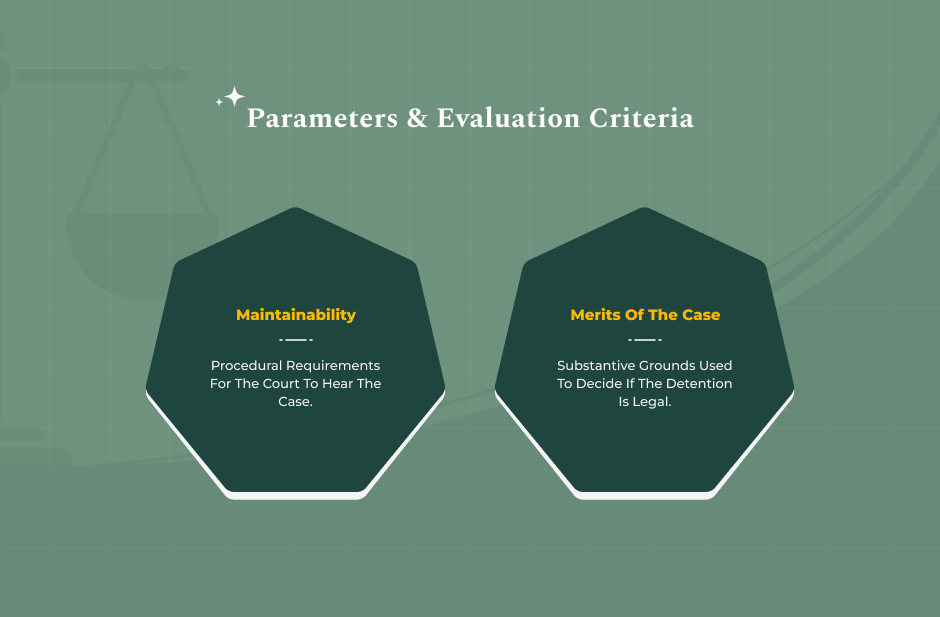
The evaluation of such a writ generally depends on two legal parameters. These are:
- Maintainability: Procedural requirements for the court to hear the case.
- Merits of the Case: Substantive grounds used to decide if the detention is legal.
Here’s what you need to know:
1. Key Legal Parameters (Maintainability)
A Court of Law must first determine whether the case before it has met the requirements set forth in either local or state law prior to considering how to address the “why” for the detention of the Detainee.
The Court must first ascertain all of the following requirements in order to release the Detainee:
- Custody Status: The person must be either physically or constructively detained when the Petition is filed with the Court.
- Territorial Jurisdiction: The detaining authority and the location where the Detainee is being detained must fall within the physical territorial limits of the Court.
- Locus Standi (Relaxed): With the Writ of Habeas Corpus, any person who has knowledge of the facts regarding the Detainee can file a petition on behalf of the Detainee, regardless of whether the Detainee can file the petition himself or herself.
- Exhaustion of Remedies: In some jurisdictions (such as the Federal Court in the United States), an individual seeking to file a Petition for Writ of Habeas Corpus must first exhaust all state-level appellate remedies.
2. Evaluation Criteria (Merits Of The Case)
When the court reviews a detention, the question is whether the detention complied with the law. The court typically finds a detention unlawful based on one of the following:
- No Authority: The person or agency that took the person into custody/ holds him/her had no legal authority to do so.
- Not Following Procedure: The authority did not follow the law (example- person must be brought before a magistrate within 24 hours).
- Law is Unconstitutional: The law used to take the person into custody is unconstitutional.
- Issue of Bad Faith: The agency/person taking the person into custody/making the arrest did so for a purpose other than law enforcement or with an evil intent.
- Ineffective Assistance of Counsel: After conviction, one needs to prove that the lawyer’s assistance was so deficient that he or she deprived the defendant of a fair trial.
Read Also: What Are The Valid Reasons To Get Out Of A Subpoena?
What Are The Limitations And Challenges Of The Writ Of Habeas Corpus?
Although the writ of habeas corpus is one of the most important protections for individual freedom, it faces serious challenges. Various legal, political, and systemic limitations often restrain its actual use and effectiveness.
1. Legal And Jurisdictional Limitations
To begin with, the court cannot grant the writ if a valid request is made by a properly constituted court or body when the individual was detained following a valid conviction or for either criminal charges or a lawfully issued arrest warrant.
Furthermore, the scope of a thorough investigation or inquiry through habeas corpus also has limitations.
For instance, the writ is strictly a procedural device to check the legality of detention. One cannot use it to direct an investigating officer on how to conduct a probe or to trace a missing person or a dead body.
2. Situational And Emergency Challenges
Several countries provide for suspension of the writ during the existence of rebellion, invasion, or national emergency, should such suspension be necessary for public safety.
For example, the ADM Jabalpur case – where the Supreme Court, in a controversial and highly debated decision, held that a person’s right of filing for habeas corpus could be suspended during the emergency declared in 1975.
When “national security” or “public safety” is at issue, courts tend to accord significant deference to the state, particularly in cases involving preventive detention laws.
3. Practical And Systemic Hurdles
The time required to bring forth an effective writ is essential. However, systemic delays arising from backlogs in the court process can prevent the timely presentation and disposition of petitions, which can result in further illegal detention.
Additionally, in order to prevail in your application for the writ, you must establish a prima facie case of your illegal detention.
However, if the applicant does not know about the detainee’s location, the court might dismiss the applicant’s request for the writ for lack of evidence.
Often, the most vulnerable members of society (such as marginalized communities and individuals engaged in political dissent) face an awfully disproportionate impediment to accessing legal aid and the information needed to effectively invoke the writ.