Quo Warranto is an essential legal tool that guarantees qualified persons occupy public offices of trust. This ancient mandate literally demands that a holder of power “by what authority” they do so. In the early part of 2026, the legal community is abuzz with several prominent cases of challenges to administrative appointments.
The present cases demonstrate that the writ is still an effective mechanism against the unlawful assumption of a public office. Since the integrity of the government hangs on legal appointments, the remedy is employed by citizens and officials alike.
In this article, we will elaborate on the following:
- The literal meaning and historical development of the writ.
- The specific legal criteria required for a court to issue the order.
- A comparison of how different jurisdictions, like the US and India, apply this law.
- Practical steps and expert tips for filing a successful petition.
What Is Quo Warranto?
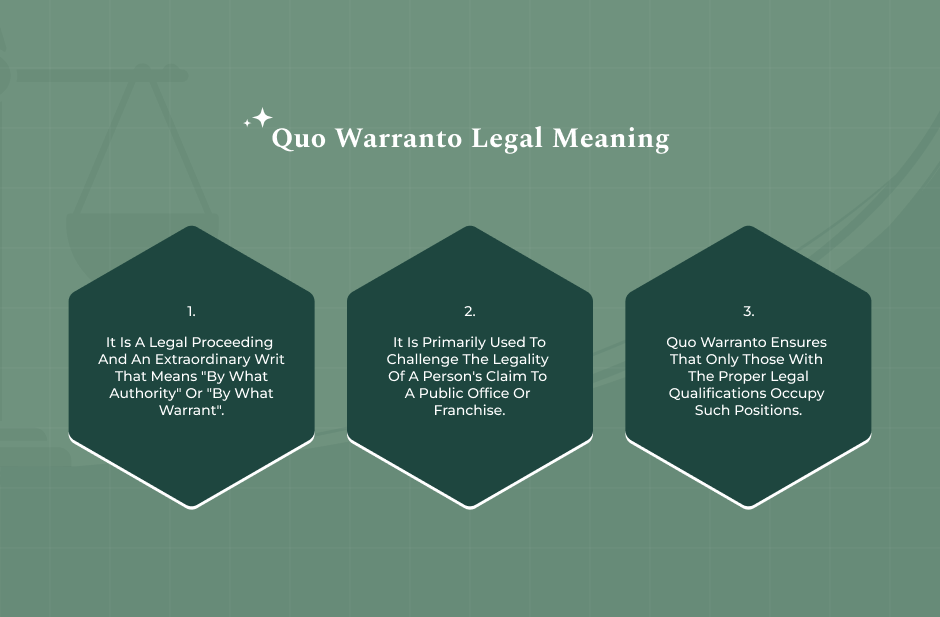
A Quo Warranto is a legal remedy that questions the validity of an individual’s occupancy of a public office, franchise, or privilege.
It serves as a protective device for the public, thereby preventing individuals who are not qualified enough from making decisions that impact the community.
The judiciary employs this mechanism to scrutinize the validity of an individual’s occupancy of their office.
If the individual fails to demonstrate the existence of legal authority, the judiciary strips them of their office.
This serves to promote the rule of law because no one is exempt from the requirements of their office. (Source: Merriam-Webster).
Meaning & Legal Definition
The word Quo Warranto has immense legal significance since it is aimed at the very root of the official’s authority.
It is not concerned with how they exercise their authority, but whether they have the right to exercise the authority in the first place.
The modern legal systems use the meaning of Quo Warranto to establish the limits of the executive and administrative authority.
It ensures that all individuals holding a “substantive” position have fulfilled the requirements laid down by law.
Etymology And It’s Literal Meaning
The expression “Quo Warranto” is derived from Medieval Latin. It is translated as “by what warrant” or “by what authority“.
In the past, this question was asked by the King’s courts to anyone who claimed a right or liberty that was normally reserved for the King.
Legal Definitions Across Sources
According to Cornell Law School Legal Information Institute, “Quo Warranto” is a common law remedy that is used to challenge the right of an individual to hold a public or corporate office.
Although the definitions are the same, it is sometimes used more for corporate charters than for political offices.
Historical Origins & Evolution Of Quo Warranto

The Quo Warranto writ has transformed from being a King’s tool to a people’s tool. This is because the process has transformed from being under a monarchy to being under a democracy, where the law, and not a human being, is supreme.
Additionally, historically, the writ was used by the monarch to reclaim land or rights that were illegally held.
Today, the Quo Warranto definition is associated with safeguarding the democratic process against corruption and nepotism.
Common Law Roots In England
In ancient English law, the Crown employed the Quo Warranto writ to prevent “usurpers” from exercising royal prerogatives.
When an individual sought a market right or a local position without a royal charter, the King’s Bench would call upon them to justify their claim.
Modern Law Development
With the evolution of modern law, the writ became a civil action. Today, most nations permit public prosecutors or even individuals to file the petition.
This is to ensure that even if the government is indifferent, the people can still hold the government accountable for illegal appointments
Purpose Of Quo Warranto
The primary purpose of Quo Warranto is to maintain the purity of public administration. It is a scanner that scans the eligibility of people holding key positions in public administration.
By filtering out the unqualified individuals, the writ prevents abuse of power. It also protects the rights of individuals who were lawfully qualified for the position but were ignored in favor of an underqualified individual.
This serves as an assurance that the “will of the law” is given due consideration over the “will of the politician”.
Thus, the purpose of this writ can be listed below:
- Maintaining Public Accountability
- Scans the eligibility of public officials.
- Avoids Nepotism and illegal appointments.
- Safeguards the rights of qualified individuals.
Lastly, it helps maintain a transparent standard of government administration
Legal Criteria & Conditions For Issuance
A court will not issue a Quo Warranto simply because a citizen is dissatisfied with an official. The petitioner must show that the case satisfies strict legal requirements.
If the requirements are not satisfied, the court will automatically void the petition. This is to ensure that the legal system is not abused for trivial political squabbles or “vexatious” lawsuits.
Office Must Be Public & Substantive
The writ is only valid against a “substantive” public office. This requires that the office be permanent and established by statute or the Constitution.
It is not valid against private employees or low-ranking clerks whose offices are not established by law.
Holder Must Lack Authority Or Qualification
The petitioner must show that the office holder is unqualified. This may be because they:
- Do not have a required degree.
- Failed to satisfy an age requirement.
- Were appointed in a manner that is illegal.
Additionally, even if they were qualified initially but lost that status later, the Quo Warranto is still valid.
Actual Possession Of Office Required
The defendant must be in “actual possession” of the office. You cannot bring a Quo Warranto action against someone who is contemplating assuming the office. They must be actively exercising the powers and privileges of the office.
Who Can File A Quo Warranto Petition?
The requirements for “standing” to file differ by jurisdiction. Nevertheless, the Quo Warranto definition is distinct because it usually allows more access than other forms of legal writs.
In most jurisdictions, the Attorney General or a prosecutor initiates the case. In other jurisdictions, such as India, any concerned citizen can initiate a petition for a Quo Warranto writ.
This is because all citizens have a vested interest in ensuring that public offices are filled in accordance with the law.
Recent U.S. Legal Cases On Quo Warranto
The United States has recently witnessed a revival in the use of the Quo Warranto writ to resolve disputes over government form and executive authority.
These cases frequently reach the highest courts in the land because they raise basic constitutional issues about who has the right to lead.
In 2025 and 2026, various states and government agencies have been subject to these “extraordinary” petitions. The following points highlight the most recent developments in American law.
Minnesota Quorum Dispute (2025)
The Minnesota Supreme Court ruled in Simon v. Demuth that a quorum of 68 members is required in the House. This blocked the illegal election of a Speaker and the formation of the House by a minority group.
Federal Reserve Board Independence (2026)
The Supreme Court is currently ruling in Trump v. Cook on whether a President can remove a Federal Reserve Governor without adhering to certain “for cause” statutory requirements. This matter raises the boundaries of removal authority.
Florida Legislator Access (2025)
A Quo Warranto petition was filed by Florida legislators in the state Supreme Court to challenge the emergency powers of Governor DeSantis.
They demanded access to an immigrant detention center operated by the state, which they claimed was outside the Governor’s authority.
Challenge To Local Eligibility (2025)
In Bailey v. Laurie, a Florida court examined a Quo Warranto writ in a case where an official was removed for a federal felony. The ruling established that out-of-state restorations of rights do not automatically make someone eligible for a Florida office
Quo Warranto Vs Other Legal Remedies
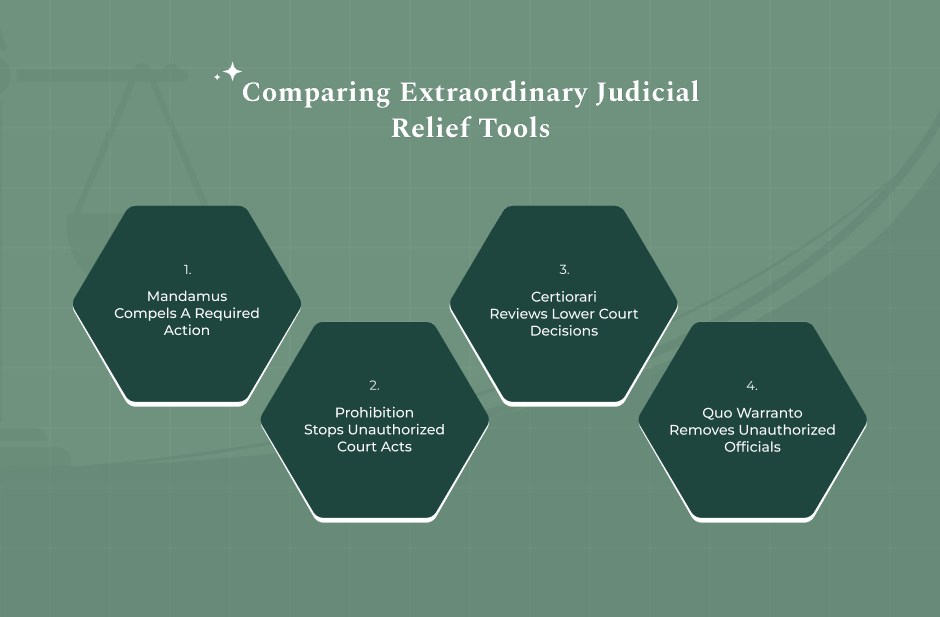
It is very simple to get Quo Warranto mixed up with other types of writs. But each one has a very specific “surgical” application in the courtroom.
Take, for instance, a Mandamus. This is an order for an official to carry out their duty. A Prohibition prevents a lower court from proceeding. But a Quo Warranto is the only writ that removes an individual from an office they don’t belong in.
Expert Tips
If you are planning to file a Quo Warranto, you have to build an ironclad case. These are considered “extraordinary” relief and will be denied on any possible grounds.
- Confirm the Office: Make sure that the office in question is indeed “public” and “substantive.” Otherwise, the writ will be deemed invalid.
- Assemble Hard Evidence: Assemble diplomas, birth certificates, or appointment records that will show a lack of qualification. Rumors will not do.
- Be Prompt: While there is no time limit in some states, “delay” (laches) is a frequent ground for denying a Quo Warranto.
Therefore, the Quo Warranto definition will always revolve around one thing: “By what authority?” It is a crucial mechanism for ensuring the validity of public and corporate positions.
With the knowledge of the Quo Warranto writ, the public and lawyers can effectively resist the unlawful exercise of power.
To do this, one must demonstrate that the position is substantial, public, and occupied by an unqualified individual. Regardless of whether it is in the US or India, the writ enforces the rule of law.
Frequently Asked Questions (FAQs):
The legal system can be perplexing, particularly when it involves historical Latin phrases. These questions address typical issues that the public encounters with respect to the Quo Warranto definition in contemporary society.
Learning how to apply the Quo Warranto writ is the key to making governments accountable. These responses will address the application of the Quo Warranto writ in the 2026 legal environment.
Not typically. The description of Quo Warranto is usually limited to public office in most nations.
But in the United States, there are states that permit the filing of a Quo Warranto writ to contest a corporate office if the corporate charter is implicated.
You would have to look into your state’s statutes or the Legal Information Institute for more information on corporate disputes.
If your Quo Warranto petition is denied, the public official retains his position.
You may also be assessed for the other party’s attorney fees if the court determines that your lawsuit was “frivolous” or that you filed it as an act of harassment.
This is why an “indisputable factual foundation” is so crucial.
No, they are not the same. An election contest is a specific legal process for counting votes. A Quo Warranto is a contest questioning the winner’s right to hold the position after the election.
For instance, if the winner of the election is not a resident of the district as required by law, you would file a Quo Warranto to remove them.