A Writ of Mandamus is a strong judicial order that compels a government official or an inferior court to carry out a mandatory obligation.
This is a legal remedy that ensures government officials do not disregard their legal duties to the people they serve.
At the start of 2026, the legal fraternity is following a number of major cases involving delays by federal agencies.
In particular, a huge mandamus case is already ongoing in the D.C. Circuit Court involving unprecedented delays in professional visas.
This case illustrates how people employ the Writ Of Mandamus to overcome bureaucratic delays.
Historically, the Supreme Court case of Marbury v. Madison introduced this idea to the forefront of American law.
Today, it is a critical legal remedy for administrative accountability. Since the court only issues this on particular grounds, you need to know the rules that regulate its issuance.
In this article, we will elaborate on the following:
- The core legal definition and the historical origins of the command.
- Specific criteria that a petitioner must meet to win their case.
- Different categories of the writ and how they apply to various legal scenarios.
- A comparison between this remedy and other judicial orders, like prohibition.
What Is A Writ Of Mandamus?
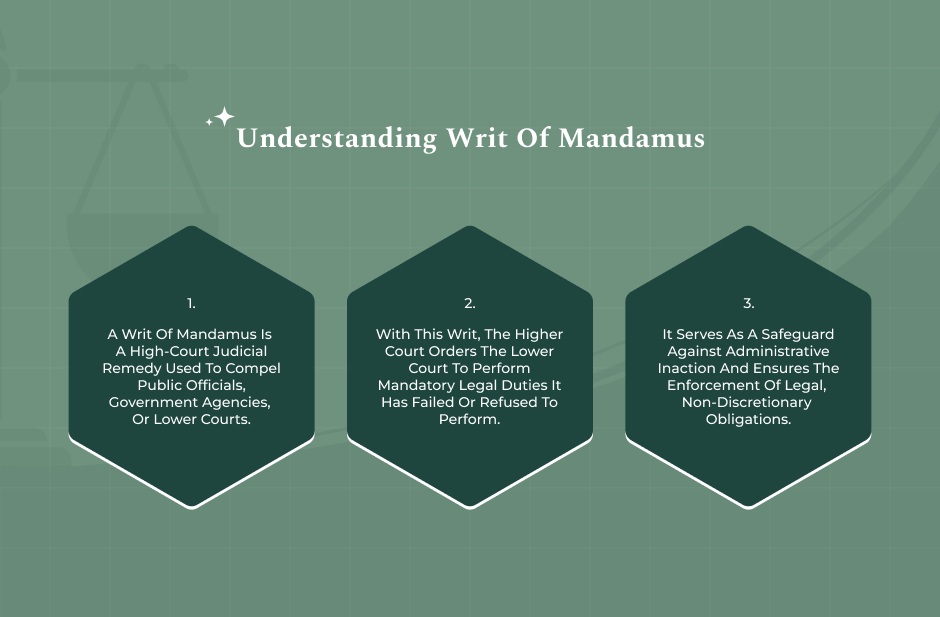
The Writ Of Mandamus is a remedy that is employed when there is no other legal avenue left to address a situation. It is a way of telling a public official, “do your job.”
The courts are reluctant to issue such a mandate because it impacts the day-to-day functioning of the executive branch of government.
The mandate is directed at ministerial acts. A ministerial act is an action that a public official is required to do by law without exercising discretion.
For example, if you have done everything necessary for a permit, the official is supposed to issue it to you.
If they do not, the Writ Of Mandamus is the remedy that will give you the push you need to get your rights.
Legal Definition & Origins
In order to grasp the meaning of the Writ Of Mandamus, it is necessary to examine the linguistic and historical origins of this writ.
The origin of the word mandamus is derived from the Latin word that translates to “we command.” This is a reflection of the power of the sovereign or the state to guarantee justice for its citizens.
The writ of mandamus definition in contemporary courts defines the command issued by the superior court to any person, corporation, or inferior court (Source: Merriam-Webster).
Mandamus Meaning And Etymology
The meaning of mandamus revolves around the concept of a mandatory order. Mandamus is an order that is binding in nature. Unlike a request or an injunction, mandamus is an order that one has to follow. Failure to comply with a Mandamus Writ may lead to contempt of court charges against the concerned official.
Historical Development
The concept of mandamus developed from the common law of England. The King’s Bench developed it to control its subordinate officials.
Over the years, it developed in the United States of America and other democratic nations. Today, it is a cornerstone of administrative law worldwide.
How A Writ Of Mandamus Works
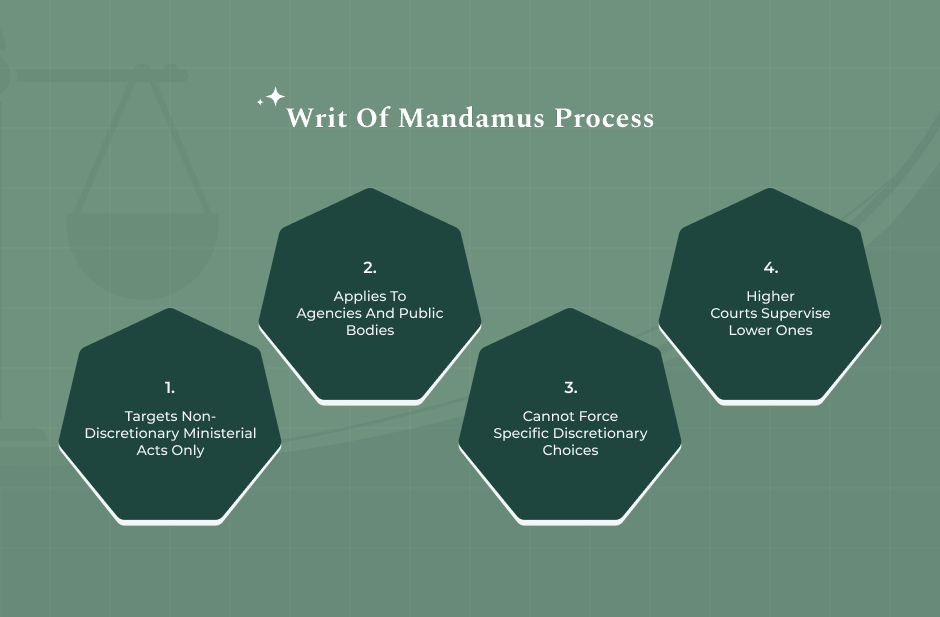
The Writ concentrates on obligations that are clearly specified in statute. It cannot instruct an official on how to solve a complicated problem. It can only be used if the statute requires the official to behave in a certain manner.
What It Can Compel
The writ forces the carrying out of a “ministerial” act. This is an act that the official cannot avoid. For instance, if a clerk is required to register a deed by law but fails to do so, a Writ Of Mandamus can compel the registration.
Who Can Be Compelled
You may bring this action against different defendants. These include government officials, administrative agencies, and public bodies.
It also includes lower court judges who have failed to conduct a hearing or make a decision that the law requires.
When It Cannot Be Used
The Writ Of Mandamus cannot be used to control a “discretionary” act. If a person has the legal right to make a choice between two options, the court will not interfere. The writ is for missing actions, not actions you simply dislike.
Legal Criteria & Parameters
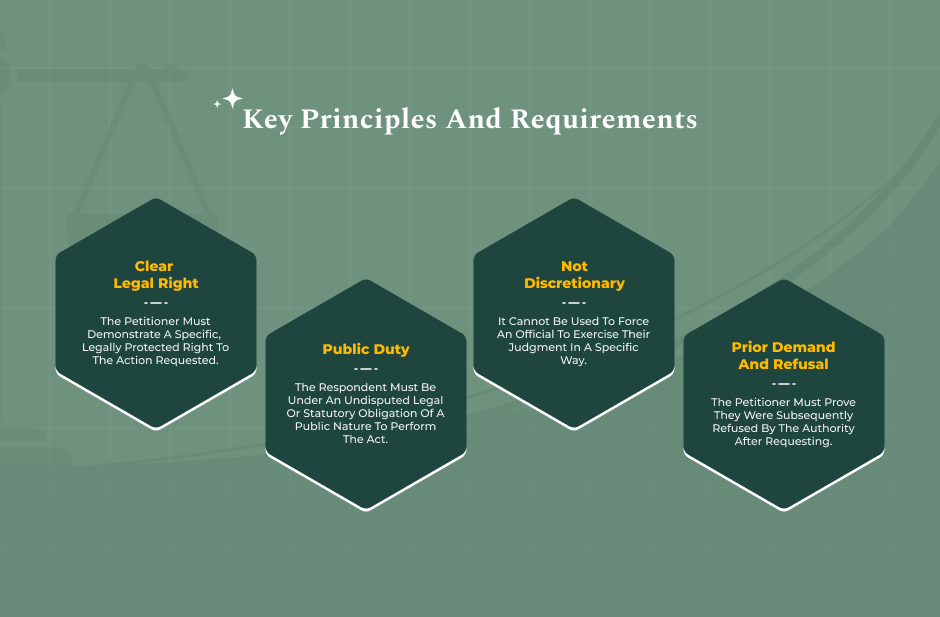
In order to obtain a Writ Of Mandamus, you must prove a very high burden of proof. The court will demand that you prove you have exhausted all other alternatives. This is to ensure that the writ is only used as a last resort for extreme cases.
Clear Legal Duty Required
First, the petitioner must show a “clear and indisputable” right to the relief they are seeking. You must show that the law specifically requires the respondent to perform the act. If the law is not clear or is ambiguous, the court will most likely refuse the Writ Of Mandamus.
No Other Adequate Remedy
Mandamus relief is only available if “no other adequate remedy” is available. If you can appeal the case or file suit for damages, the court will likely tell you to do that instead. It is the “emergency exit” of the legal world.
Discretion Vs Ministerial Duty
The distinction between these two types of duties is the heart of every Writ of Mandamus case. A ministerial duty involves no personal judgment, such as the duty to issue a marriage license when all forms are signed. A discretionary duty involves a choice, such as deciding who to hire for a government job. The writ only applies to the former.
Types Of Writs Of Mandamus
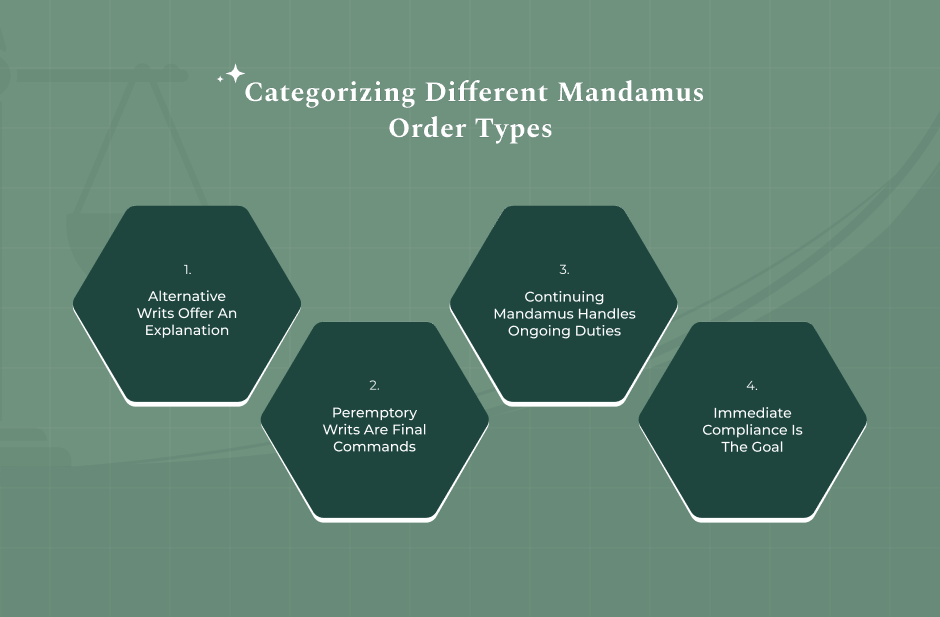
Not all Writs Of Mandamus are alike. Based on the level of urgency and the point in the legal process, the court may issue different forms of the Writ.
Alternative Writ Of Mandamus
The “alternative” Writ is the initial action. It commands the official to carry out the obligation or appear in court to justify why they have not done so. This establishes a hearing where the official can justify their delay or failure to act.
Peremptory Writ Of Mandamus
The “peremptory” form is the final and absolute Writ. The court issues it after the hearing of the arguments and the determination that the official must take immediate action. There is no further need for justification after the court issues this form of the Writ.
Continuing Mandamus
In some jurisdictions, such as India, there is a “continuing mandamus.” This is a Writ that permits the court to retain a case for many years to ensure that the public body continues to carry out its obligation. This is particularly true in cases involving environmental issues, such as a river that a city must clean.
Mandamus In Different Legal Systems
Although the Writ has English origins, it has evolved to suit different countries. Each country employs it to limit the power of the government in a slightly different manner.
United States Context
In the US, federal courts base their power on 28 U.S.C. §1361. This statute permits the federal district courts to issue a mandate to any officer or employee of the United States to perform a duty. It is most commonly employed against agencies such as USCIS or the Social Security Administration.
Indian Constitutional Law
In India, the scope of this writ is very wide. Citizens have the right to approach the Supreme Court or High Courts directly to file a Writ Of Mandamus under Articles 32 and 226 of the Indian Constitution. It is a basic right to enforce constitutional obligations and basic human rights.
Mandamus Vs Other Legal Remedies
It is necessary to differentiate Mandamus from other “extraordinary” writs. Although all of them originate from superior courts, they play entirely different roles in the judicial system.
Mandamus Vs Prohibition
A Writ of Prohibition prevents a lower court from doing something it is not authorized to do. On the other hand, a Mandamus compels a court to do something it is supposed to be doing but is not. One is a red light, and the other is a green light.
Mandamus Vs Certiorari
A Writ of Certiorari is employed to review a decision that has already been rendered by a lower court. A Mandamus is employed before a decision is rendered, typically when the lower court is sitting on its hands and doing nothing.
Expert Tips & Best Practices
If you are thinking of filing for a Mandamus, you will need a good plan. As these cases are hard to win, your preparation work has to be perfect from the very start of filing.
Exhaust All Options
You have to show that you have attempted every other means to get the agency to take action. Keep records of your follow-up emails and phone calls.
Establish The Duty
Make sure that the law actually gives no leeway for the official to claim “no.” If they have a choice, your petition will not be granted.
Know The Timeline
Do not file your claim too soon. A two-month wait may be “reasonable” to a judge, but two years is usually sufficient to warrant a Writ Of Mandamus.
A Wrap Up!
The Writ Of Mandamus is a significant instrument of justice in the year 2026. This is because it prevents the government from ignoring the law by doing nothing.
To make this instrument work for your benefit, you must be aware of the mandamus definition and the high standards of evidence.
Whether you are struggling with a stuck permit, a stuck court case, or an immigration problem, this writ will ensure that the machinery of the government is in motion.
You must not forget that the court requires a clear legal duty and the lack of other options before it can act.
A mandamus lawsuit may be serious business, but it is often the only option available to force public officials to follow the laws they have sworn to uphold.
Frequently Asked Questions:
The legal community frequently employs technical terminology that confuses the layman. The following questions cover the most frequently asked issues regarding the Writ Of Mandamus in today’s legal environment.
As government agencies increasingly go online, the term “unreasonable delay” is evolving. The following answers shed light on how the Writ Of Mandamus can be used to solve the issues of today that affect citizens.
The success rate depends on the agency. Often, the government will do what you want (e.g., approve a visa) immediately after you file the lawsuit so that they won’t have to go to court. This is called “voluntary mooting” of the case.
Since the government understands that a Writ Of Mandamus is a serious threat, filing the lawsuit will often get you what you want.
No, they are different. An injunction is a general remedy that can stop a person from doing something or order them to do something, and it can be issued against a private citizen.
A Writ Of Mandamus is an “extraordinary” remedy that is specifically targeted against public officials and lower courts. It has much more stringent requirements than a standard preliminary injunction.
Generally, no. The purpose of this writ is to order an official to do something, not to punish them with a fine.
If you want compensation for the delay, you would generally have to file a separate civil lawsuit. The Writ Of Mandamus is strictly about ordering the performance of the legal duty itself.