Today’s topic of discussion: What does disposed mean in court?
In court, the judges use words like “disposed” when they complete the proceedings of the case. In simple words, it means that the case is closed.
After the court announces that a particular case is disposed of, they remove ot from the docket of the ongoing cases.
In this blog, we will break down the following things:
- What does disposed mean in court?
- How does the court dispose of a case?
- The difference (if any) between Disposed vs Dismissed vs Closed in court.
- How does this status impact criminal and civil cases in court?
- Can you reopen a disposed case in court?
Therefore, if these are a few things that you want to know, keep on reading this blog till the end…
What Does Disposed Mean In Court?
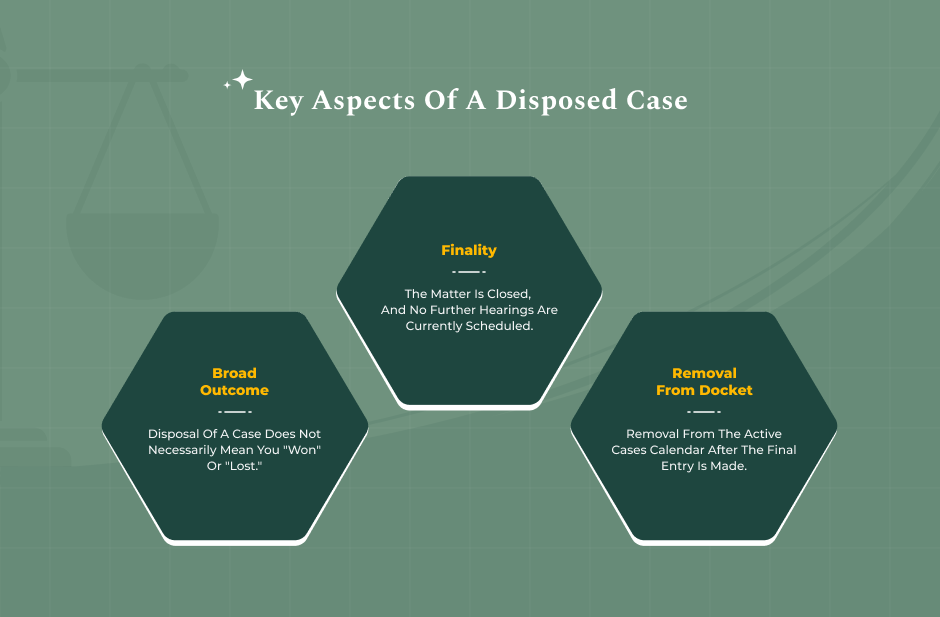
According to Legal Clarity, the status of a “disposed” case in the court signifies that “a final legal outcome has been reached.” It means that no further dates will be added to the court’s calendar regarding this case.
Justia clearly defines the legal meaning of this word/status in court. According to their legal dictionary, it is “to settle or resolve a matter categorically.”
How Is A Case Disposed In Court?
A case can be closed for a variety of different reasons. In some situations, you cannot reopen a case ever. However, in other situations, you can do so even after the case is disposed of in court.
In order to understand that, it is important to learn about the various grounds or categories on which the court disposes a case.
Here’s what you need to know:
1. Dismissal With Prejudice
A case dismissed with prejudice will never be reopened and retried. That means if a case is dismissed with prejudice, one thing is clear: the judge believes, based on the merits of this case, that it will never be looked at again.
2. Dismissal Without Prejudice
If the judge discharges you from the case “without prejudice,” it means you will be let off free. However, the district attorney can theoretically charge you again with the same conduct.
In most cases, the judge might have a technical issue with the case the district attorney is presenting against you. If the district attorney resolves the issue, you might find yourself facing trial again.
3. A Guilty Verdict
Either the judge or the jury gives a guilty verdict after considering the evidence that is present in court.
In both situations, the prosecution presented the evidence to the court. Additionally, both sides have the opportunity to present their case. The court disposes of a case after sentencing, following a guilty verdict.
4. Guilty Plea
If you plead guilty, there is no need for a trial because the purpose of a trial is to prove that you are guilty. Most guilty pleas are a result of a plea bargain.
A plea bargain is an agreement between you and the prosecutors where you plead guilty to a lesser offense, and they will request the trial judge to accept your guilty plea.
The trial judge is not bound to follow the prosecutor’s recommendation, but they usually follow it. Plea bargains are far more common than trials.
5. The Not Guilty Verdict
Therefore, upon the evaluation of the evidence presented in a case, a jury or the judge has ruled that the accused person is not guilty of the offense that has been leveled against them. After this verdict has been recorded in the case, the case becomes disposed of, and no trial will follow.
6. Double Jeopardy
Under the rule of double jeopardy, according to the US Constitution, the court cannot charge you twice for the same crime.
However, there is one loophole. For some crimes, you can be charged with both state and federal offenses.
7. Default Judgment
Finally, the court can dispose of a case by entering a default judgment. Default judgment takes place in a civil case if the defendant neither responds to an action filed against him or her nor appears in court within the prescribed time.
Additionally, in such a situation, the court gives a decision in favor of the plaintiff without necessarily having to go to trial.
Disposed vs Closed: Key Difference Explained
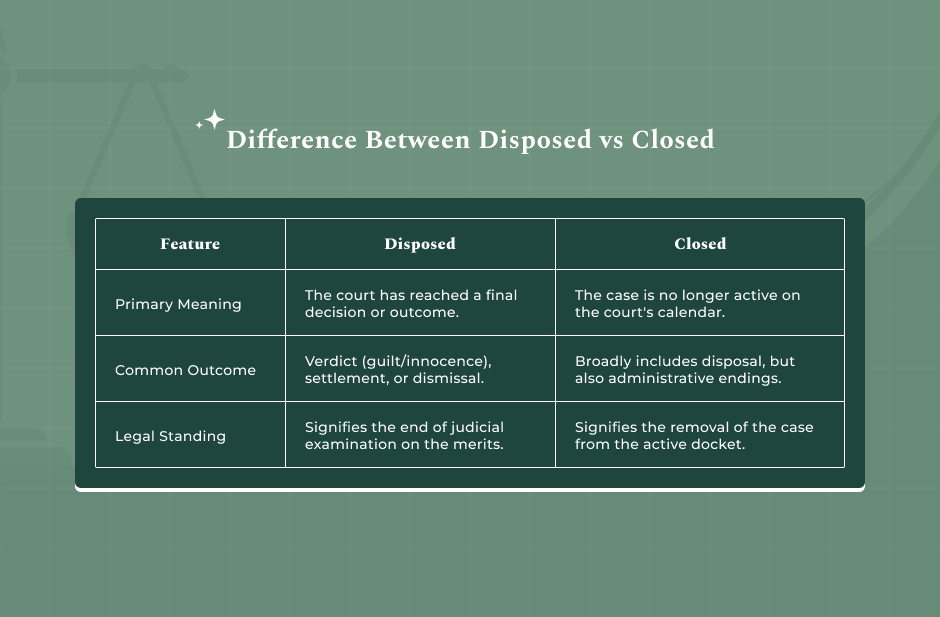
“Disposed” and “closed” are two phrases that describe the completion of a case. Although people often use these two terms synonymously, they represent two technical differences.
For instance, one refers to the ending of a case and the other refers to the completion of a case from the judicial standpoint.
“Disposed” means that the judiciary has made an order and/or rendered it regarding a case to decide the issues raised before the court.
On the other hand, “Closed” refers to an administrative status. Once a case has been terminated or is final in its disposition, the court clerk completes the final administrative procedures.
Generally, such procedures include entering the judgment and verifying that all costs have been paid. Once the administrative procedures are finished, the court closes the case.
Please note that a case has to be final before the court closes it.
What Happens After A Case Is Disposed?
Now that you are aware of the answer to what does disposed mean in court, you might be wondering what happens following this.
What will happen next is completely dependent on the outcome. For example, if there has been a judgment in a civil case for damages, the next step is payment. If this has not occurred, then the party that won the case can take the process of collecting a start.
For there to be a conviction of a crime, the culprit must comply with the sentence that could include paying fines to the state, going to jail, or probation.
The appeal can take place based on the determination of a case, for instance, the outcome of a case after a trial, within a specified timeframe allowed for filing an appeal.
For instance, in civil matters before the federal court, a party has between 30 to 60 days to appeal. On the other hand, in federal crime charges, one has only 14 days to appeal as a defendant.
1. Expungement
Even those who have committed a felony and have been disposed of can have their case expunged. This is known as expungement.
This will often have to be done with the help of an attorney and can be a long process, but yes, it can be accomplished.
Even if an expungement is granted, one will not have to disclose their felony conviction to the general public, including most employers and landlords.
2. Sealed Records
If the record is impossible to expunge, then there might be individuals whose conviction is sealed. If the case is the same, then it means that the details of the crime and the conviction are not available for the wider public.
Frequently Asked Questions (FAQs):
Now that you know about “what does disposed mean in court,” here are a few questions that people often ask about this. Please take a look at them before leaving:
When the court passes a disposed status, it does not necessarily translate to winning or losing a case. Rather, it only signifies that the court has already reached a final judgment and thus is no longer active on its docket.
Yes, a discharged charge of a crime will definitely appear on your record as a disposed charge. Although the term “disposed” indicates that the matter has concluded, the charge actually will be retained in public records.
Yes, you have the right to reopen a case after it is closed, although it is not an absolute right. In the United States, you are required to file a Motion to Vacate Judgment or a Motion to Reopen in the court through which the original judgment was rendered.
Since the judicial system recognizes the concept of finality, courts only accede to such requests in extraordinary circumstances where a specific legal ground exists.