
Immigration bond hearings stand between incarceration of those currently under the control of the Immigration and Customs Enforcement agency, or ICE, and the liberty that these incarcerated detainees seek.
When the government detains an alien, the judge must determine if the alien can safely return home pending the outcome of the case (Department of Justice). This is where hard work and preparation mean the difference between returning home to a hot meal and staying in a hotel that’s got a mystery meat sandwich on their “gourmet” menu.
Immigration bond hearings are what decide who can be released while their cases are pending. Here’s what you’ll be learning about them in this article.
- Judges assess flight risk and threats to public safety.
- The lowest possible bond is fixed at $1,500.
- There is mandatory detention for serious types of criminal records.
- Being closely tied to the community or having good familial bonds can also go a long way.
- Payment needs to be made through a money order at ICE.
- Originals or certified translations are always handy evidence.
What Is An Immigration Bond Hearing?
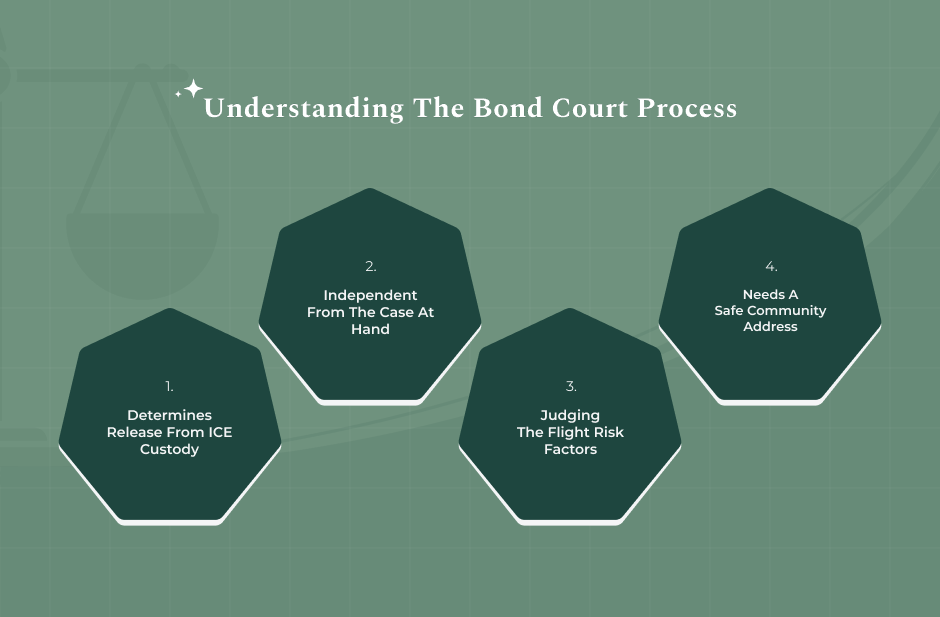
An immigration bond hearing is a court proceeding in which an Immigration Judge examines an individual’s custody classification. This is not the trial at which you will decide whether or not you will remain in the country.
It is simply to decide whether or not you will be free while awaiting the decision, explains the Department of Justice.
The Role Of The Judge
Firstly, the hearings conducted by the immigration authorities regarding the immigration bonds involve the judge as an independent third-party arbiter, who sits between the detained immigrant and the attorneys for the government.
Even though the initial high bond might be set by ICE or the government, the judge can then reduce the amount and even grant the immigrant their freedom where necessary.
Legal Standards For Release
The way to succeed is to demonstrate you are not a “flight risk,” meaning you will not flee, and that you do not pose a hazard to others.
The fact that you have never inadvertently swiped a grape from the grocery store checkout stand puts you one step ahead already.
What Is The Eligibility For A Bond Hearing?

Not all detainees are eligible to apply for immigration bond hearings. Certain individuals are considered part of the group of “mandatory detention” based on the nature of their immigration or their criminal record.
Usually, those who enter without inspection are categorically denied bond under “mandatory detention.”
However, it is to be noted that in Maldonado Bautista v. Santacruz, it was held that individuals who entered without inspection have a right to immigration bond hearings under 8 U.S.C. § 1226(a).
General Eligibility And Exceptions
In general, if you are not considered an “arriving alien” at the port of entry and do not have certain serious convictions, you are entitled to a bond hearing.
These guidelines and others, however, are often shifted by new policy and court decisions.
An ICE memo from 2025, for instance, could affect the initial bond hearings for people before they meet with the judge.
Such an arriving alien is also subject to a release through Humanitarian Parole.
Common Disqualifiers
People who have convictions related to “aggravated felonies” and “moral turpitude” are likely candidates for mandatory detention.
If your record sounds like a blockbuster action film, a bail bonds connection could be a tough nut to crack.
How Bond Amounts Are Determined
When immigration bonds are presided over, judges are concerned with several issues to arrive at a figure.
The lowest possible level of immigration bonds that are legally set is $1,500. However, immigration bonds can be significantly higher depending on the level of risk (Department of Justice).
Factors The Judge Considers
The judge will evaluate your ties to family that are already in the U.S., your employment history, and how long you have been here.
They will examine your equities, which is a legal term that means “all the good things that have happened to you since you got here.
And if you’re a pillar of your community, make sure that the judge is aware of that.
Evaluation Criteria
Based on your fixed address and past record of appearing in court for other hearings, the judge will determine the level of risk you pose.
If you have a record of switching addresses every two weeks, the judge might suspect that you are even more elusive than a lone sock in a laundry basket.
Step-By-Step: Requesting A Bond Hearing
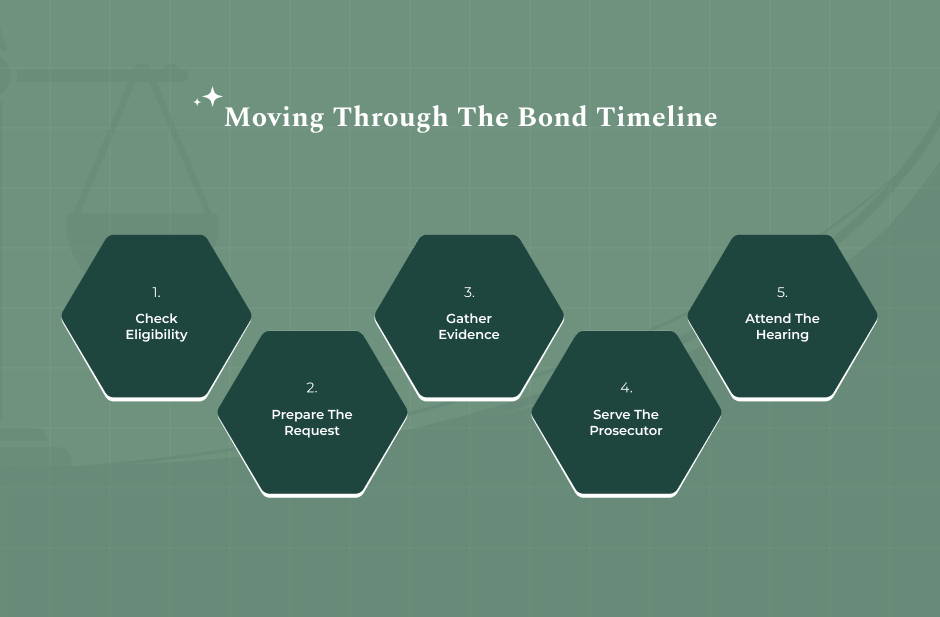
You can act on the matter yourself, and you do not have to wait for the government to act because the procedure of seeking an immigration bond hearing can start with a mere request to the court clerk or the judge.
Requesting The Hearing
You can request this as an oral matter at your first “Master Calendar hearing,” or you can request a written motion.
The latter might be quicker since you could file for entry on the bond hearings calendar of the immigration court as soon as possible.
Emergency & Expedited Requests
If the detained individual has serious medical problems or a family emergency, a hearing can be requested on an urgent basis.
Additionally, supporting medical documents must be appended when applying for the hearing.
Courts consist of jurors, who, like all other human beings, respond better when presented with serious medical situations.
Document Preparation And Listing Of Witnesses
The success of immigration bond hearings relies to a great extent on the “packet of evidence” you assemble. This is not the moment to carry a light portfolio. You’ll want a full packet of evidence demonstrating that you belong at home.
You must have the following:
- proof of identity,
- birth certificates for all of your children,
- and letters from your employer.
Most of all, you must have “affidavits of support” from friends and relatives who can “attest to your good character.
How To Argue Mitigating Circumstances
If you have a mistake in your past, you can talk about it, say you’ve learned something, and changed. Don’t try to slide it by, because the government’s lawyer has a computer and a lot of free time.
Payment Of Bond: Money, Bondsmen, and Char
After the judge gives you one of the immigration bond hearings and the price is set, you actually have to pay it. Be careful at this stage, since ICE does not accept credit card payments or IOUs.
Payment Processing
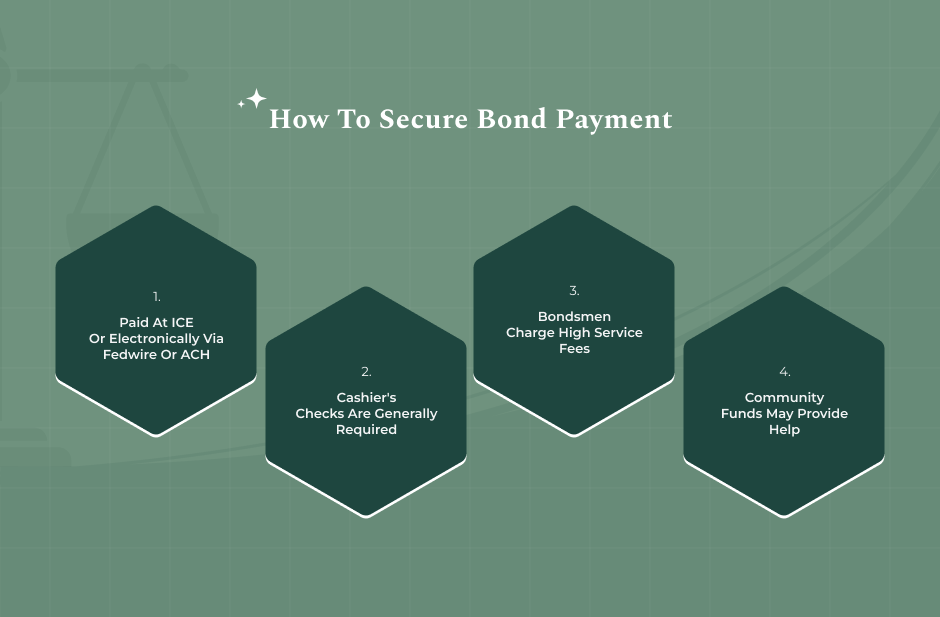
The bonds must be paid at an ICE ERO facility or electronically via Fedwire or ACH. It is always best to have a certified money order or a cashier’s check for the exact amount. Ensure the person paying the bond has a valid photo ID and a Social Security number.
Bondsmen and Charities
If the sum is too large, then an immigration bondsman may be used by some individuals.
This involves a nonrefundable upfront fee, including but not limited to 15 to 20% of the total amount due, possibly along with collateral such as the title of one’s automobile.
Also available are “bond funds,” which are given out by community groups and charities for those who do not have the ability to pay the money back, available at the portal.
Professional Recommendations And Safety Instructions
Here are the best practices to ensure smooth immigration bond hearings:
First of all, always bring original documentation with you to the hearing, but make copies for yourself. This way, when the judge asks to view the original birth certificate, you can have it ready in your hand.
Secondly, it is always a good idea to make sure you have a translation of any foreign language documentation into English.
Finally, if you have a video hearing from a detention centre, it is a good idea to dress in professional attire and make yourself clearly understood.
Read Also: VAWA Immigration Requirements: Complete 2026 Guide For Self-Petition
Frequently Asked Questions (FAQs):
Immigration bond hearings are a marathon, not a sprint. By gathering the evidence and learning the process for the immigration court bond hearings, you are giving your loved one the best possible chance at coming home.
Typically, the court aims to conduct the immigration bond hearings within a few weeks of the application.
To be sure, the backlog of the bond hearings in the immigration court may lead to delays.
Depending on the detention location, the court may conduct the court proceedings via video link (Department of Justice).
The person who is in custody can apply for this themselves, or their attorney can do so on their behalf. Even a family member can assist by securing an attorney to apply for the relief on behalf of the person in custody.
They look at your criminal record, how long you have lived in the U.S., and your family connections. They want to know that if they give you a break, you will actually return when your next court date is.