If you are wondering “how to become a barrister”, you’ve come to the right place.
Becoming a barrister is a long, rigorous, and competitive journey — but for many aspiring lawyers, it leads to a career of advocacy, litigation, and legal argumentation at the highest level.
In this article, we will explain the following things:
- What is a barrister and what is their role?
- What is the difference between a barrister and other legal professionals?
- How to become a barrister?
- Alternative routes to this legal career.
- Expert tips and advice for success in this field.
- What are the common challenges that one needs to know?
Therefore, if these are a few things that you want to know, keep on reading this blog till the end…
What Is A Barrister?
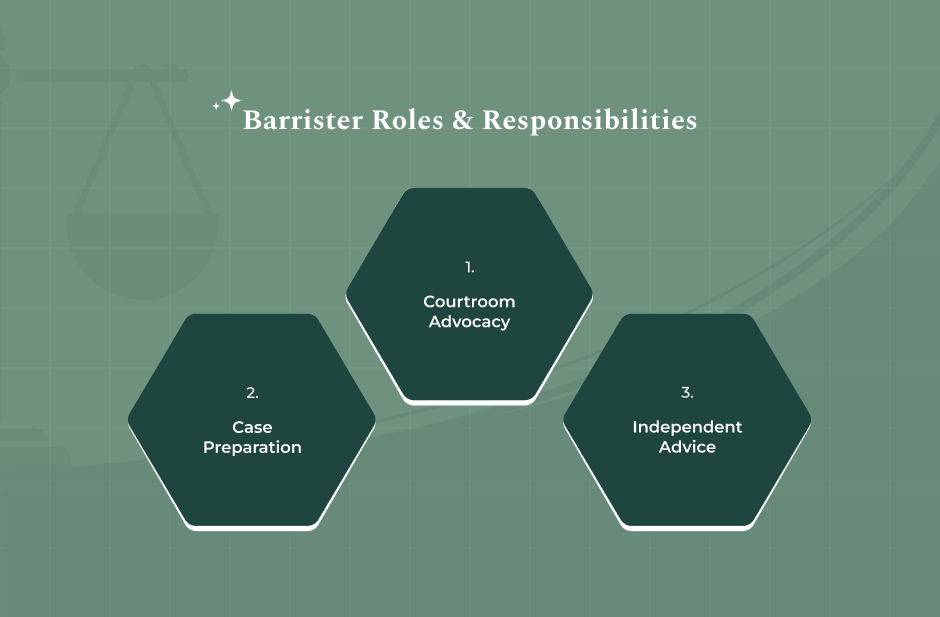
A barrister is a legal professional whose primary functions include advocacy, providing specialist legal advice, and representing clients in litigation (both criminal and civil) before courts and tribunals.
Barristers may also draft pleadings and legal opinions, and advise solicitors or clients on complex points of law.
According to the Bar Council of England and Wales, these legal professionals are “independent, objective and trained to advise clients on the strengths and weaknesses of their case.”
Role And Duties Of A Barrister
Key duties of barristers typically include:
- Appearing in court to argue cases, cross-examine witnesses, and present legal arguments (advocacy).
- Giving legal advice or opinions on complicated matters of law.
- Drafting legal documents, pleadings, court applications, or written opinions.
- Representing clients in tribunals or negotiations, especially in contentious matters.
A barrister’s work is often more specialized and court-oriented compared to other legal professionals.
Barristers vs Solicitors (And Other Legal Professionals)
Unlike barristers, solicitors generally handle matters such as transactional work, client-facing advisory tasks, document drafting, and preparing legal paperwork. Solicitors may instruct barristers when a case needs courtroom advocacy.
In many jurisdictions, solicitors and barristers perform overlapping yet distinct roles. Barristers focus on courtroom advocacy, high-stakes litigation, and court appearances; solicitors are more likely to deal with clients directly, manage cases, and perform pre-trial work.
In comparison to other legal professionals (e.g., legal executives or paralegals), barristers typically have higher-level rights of audience — that is, the right to appear before courts, tribunals — and are engaged for complex advocacy and litigation.
How To Become A Barrister?
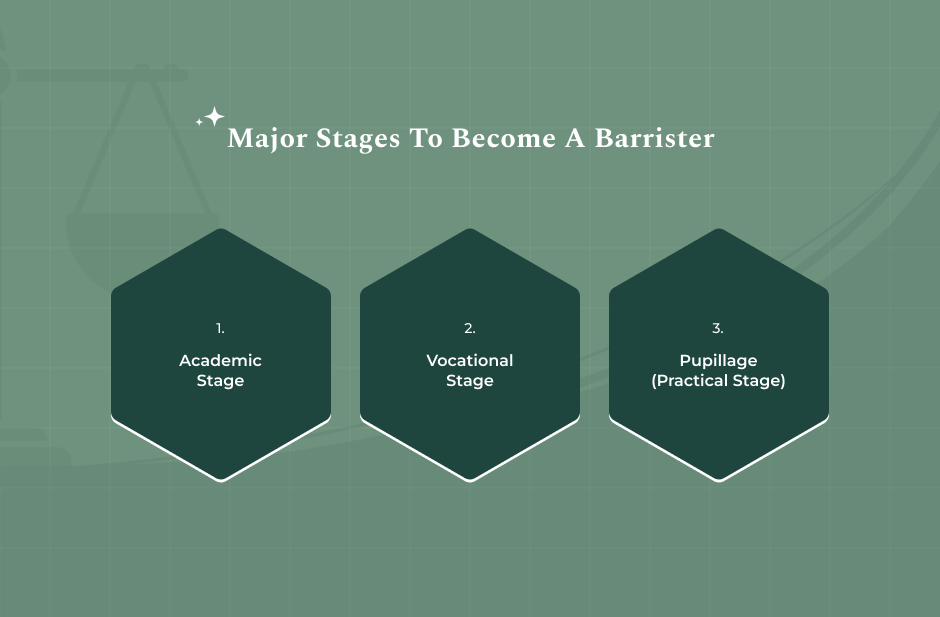
One of the most important things that you need to understand when learning about how to become a barrister is the fact that it involves meeting a sequence of regulated training stages set by the professional regulatory authority.
For instance, the Bar Standards Board clearly states that in England and Wales (the classic model), training to become a barrister is divided into three main stages:
- Academic Stage
- Vocational Stage
- Professional Stage (pupillage/work-based learning).
Let us now take a look at each stage in detail!
1. Academic Stage & Educational Requirements
Firstly, we are all well aware that becoming a lawyer or barrister can take a long time, as education and the degree can take a long time. We have divided this section into two parts:
- Law degree
- Non-law degree.
Let’s get to these parts:
Law Degree – For Graduates With A Qualifying Law Degree
According to ICCA, if you already hold a recognized undergraduate law degree (often an LLB or equivalent) — known as a “Qualifying Law Degree” (QLD) — that covers the foundational legal knowledge subjects, then you satisfy the Academic Stage requirement.
The regulatory requirement is typically a minimum undergraduate degree grade of 2:2. However, most providers of Bar training courses expect stronger grades (often 2:1).
Non-Law Degree – The Graduate Diploma in Law (GDL) Conversion Course
The ICCA is similarly instrumental in charting out the trajectory of students or future barristers lacking a conventional law background.
It is understood that if your initial degree is not in law, you are required to take a law conversion course that is most often the Graduate Diploma in Law (GDL) (also sometimes referred to as the Common Professional Examination, CPE).
The GDL has to encompass the “foundations of legal knowledge” as stipulated by the regulator. Additionally, it should be a course recognized by the regulatory authority (or, in any other case, it should enable you to get a “Certificate of Academic Standing”).
For non-UK law degrees or older degrees (often called “stale”), you may need additional assessment, or you may need to get a “Certificate of Academic Standing” from the regulator.
Additionally, according to the Regulated Professions Register, some aspiring barristers from outside the UK use the GDL as a conversion route (after obtaining a foreign/non-UK bachelor’s degree), though they may also need to satisfy additional regulatory requirements (e.g., a Certificate of Academic Standing).
2. Vocational Stage: Bar Training Course
After completing the academic requirements (law degree or GDL), you must undertake a vocational training course — commonly referred to as the Bar Training Course (formerly BPTC).
- The Bar Training Course teaches the practical and procedural skills necessary for a barrister: advocacy, conference skills, drafting, opinion writing, civil and criminal procedure, evidence, ethics, etc.
- On successful completion, you receive a postgraduate qualification (e.g., PGDip) from the course provider and a certification from the regulator that you have satisfied the vocational stage.
Entry Requirement
According to the Inns of Court College of Advocacy, the entry requirements typically demand:
- a qualifying law degree (often 2:1)
- a non-law degree plus GDL with a high grade (often Commendation or Distinction)
- Sufficient English language competence.
Note: The older entrance test (Bar Course Aptitude Test, BCAT) was abolished after July 2022 for many providers.
Costs And Funding
The Bar Training Course is not cheap. According to Postgraduate Search, the cost is typically £12,000–£20,000, depending on the provider and modules chosen.
Additional costs include:
- Inn-membership fees (for one of the four Inns of Court).
- Fees for Qualifying Sessions (pre-call events).
- Travel and living expenses.
- Call to the Bar fees.
But there are financial support options. For instance, many of the Inns provide scholarships or bursaries (often millions of pounds in aggregate each year) to GDL and Bar Course students.
Some providers also offer payment plans, and potentially Master’s-level loans if the Bar Course is packaged within an LLM program — though not all providers offer that.
3. Securing A Pupillage
Before explaining how to secure pupillage, let us explain what it is in the first place and why it is so important.
According to the Bar Standards Board, after successfully completing the Bar Training Course (vocational stage), the next step is pupillage (also called work-based learning). And it is arguably the most competitive stage.
Pupillage typically lasts 12 months, divided into two six-month periods:
- First six (“non-practising”): you shadow and assist experienced barristers, attend court, observe, and learn procedures.
- Second six (“practising”): you begin to take on your own work — under supervision — and may represent clients with a provisional practising certificate.
Only after successful completion of pupillage can you practice independently as a barrister.
How To Apply, Timelines, Competition & Tips
In general, pupillages are promoted via the official portal (e.g., the Pupillage Gateway) and directly by chambers, states Careers Service.
- The competition is so fierce that out of those who have done the Bar Course, only a handful get pupillage.
- If you want to have the highest possible chance: Create relevant experience (e.g., through mini-pupillages, mooting, pro bono work, internships), keep a strong academic record, show commitment, advocacy skills, and interpersonal abilities.
- Know that there are limits to time! According to the Legal Services Board, in quite a few jurisdictions under the regulatory regime, you are required to commence pupillage within a certain period after finishing the vocational stage (usually within 5 years) if you do not want to be obliged to take a refresher or requalification.
Pupillage Funding And Financial Support
Pupils are entitled to a minimum award (stipend) set by the regulatory board. As of recent years, for example, the minimum stipend for pupillages in London and elsewhere has been published. However, when it comes to commercial sets, especially, most chambers often pay higher than the minimum, as per Prospects.
4. Call To The Bar And Practice
Once you complete the vocational stage (Bar Training Course) and attend the required number of “qualifying sessions” with one of the four Inns of Court (e.g., Lincoln’s, Inner, Middle, or Gray’s Inn), you become eligible to be “Called to the Bar.”
Typically, as of 2020, you must attend at least 10 qualifying sessions (networking dinners, advocacy workshops, moots, conferences) before call, according to Law Cabs.
However, the Bar Standards Board states that being called does not automatically allow you to practise — you still must complete pupillage/work-based learning.
After pupillage, you apply to the regulatory body (e.g., Bar Standards Board – BSB) for your first practising certificate, which you need to practise as a registered barrister.
Once in practice, there are continuing professional development (CPD) requirements. For new practitioners, this may involve a set number of hours in advocacy training and ethics (e.g., as part of a New Practitioners Programme). And later an annual CPD plan under the Established Practitioners Programme.
Career Progression And Work Environment
Once qualified, barristers have several possible career paths and work environments:
- Many are self-employed, working from chambers (shared offices), receiving briefs from solicitors or clients.
- Some join employed roles, e.g., in government legal departments, Crown Prosecution Service (CPS), NGOs, or in-house counsel for corporations.
- Others may specialise in particular areas: commercial law, family law, criminal law, human rights, etc., potentially developing reputations that raise their earning potential.
Salary Expectations & Financial Outlook
Now that you are aware of how to become a barrister, let’s talk about the financial outlook and salary expectations.
Earnings for barristers vary significantly depending on factors such as experience, practice area, location, and whether one is working or not.
- During pupillage, minimum awards are modest (stipends), but some commercial chambers pay more.
- With experience, barristers in commercial or financial law can earn substantially more; for example, after five years in certain fields many barristers reportedly earn over £90,000.
- For those in criminal, family, or publicly-funded work, earnings may be lower, depending on volume and funding of work.
It is important to recognise that as a self-employed barrister, your income can fluctuate — based on how much work you get, your reputation, and how you build your practice.
Alternative Routes And Related Careers
Not everyone who studies law wants or is able to follow the barrister route. Some alternative or related career options include:
- Becoming a solicitor: After a law degree (or equivalent), one can follow the solicitor-specific route (in many jurisdictions, via training contracts or newer qualification frameworks) rather than bar training. This path is often more accessible and may be less competitive.
- Becoming a Chartered Legal Executive (or equivalent): This is yet another legal career path (depending on jurisdiction) that may involve less emphasis on court advocacy but still allow engaging in legal advice and representation in certain contexts.
Additionally, for some jurisdictions, there are apprenticeship routes or flexible pathways. For example, combining work-based learning with legal training rather than going to university full-time, though, for the Bar, many jurisdictions maintain the traditional academic, vocational, and pupillage model.
For qualified solicitors (or foreign-qualified lawyers) who wish to practise as barristers, there may be a transfer route (subject to regulatory requirements). These generally include taking a transfer test (e.g., for qualifying as a barrister from solicitor or foreign lawyer status) under certain circumstances.
Thus, if the full barrister route seems too daunting, alternative legal careers remain viable and respected.
Practical Advice For Applications, Interviews, & Networking

• Gain early practical exposure
• Choose your Bar course and Inn wisely
• Aim for strong academics
• Demonstrate soft-skills
• Network and build professional relationships
Challenges When Becoming A Barrister
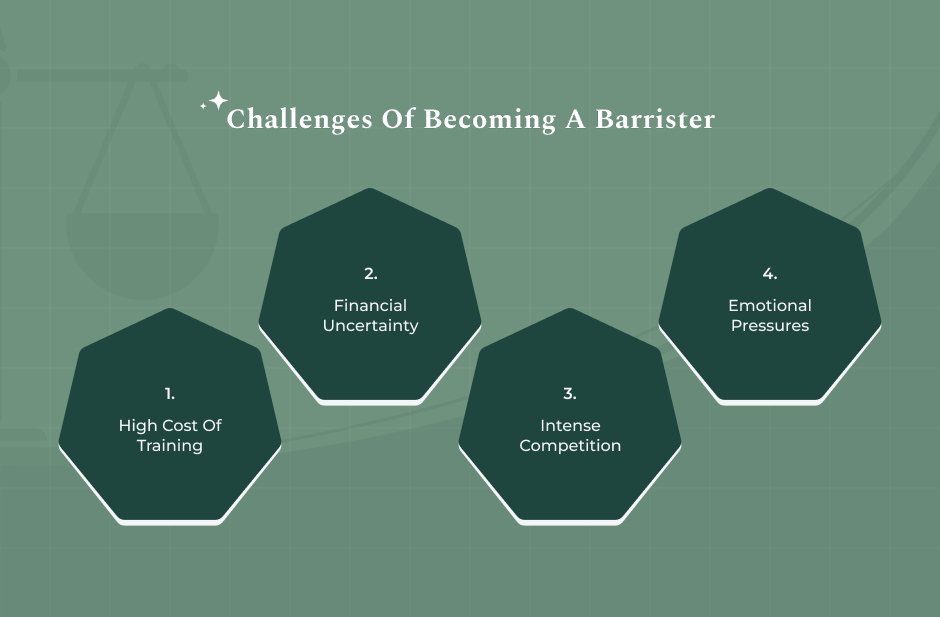
Not everything can be smooth while you are trying to achieve your goals and become a lawyer. Here are some of the major challenges that you should be aware of:
- High cost of training: Between expensive course fees, living costs (especially in London), and additional costs (Inn membership, qualifying sessions, travel, visas where applicable), the financial burden can be substantial.
- Financial uncertainty during pupillage: The stipend during pupillage may be modest; until you secure tenancy or a stable flow of work, income may fluctuate.
- Intense competition: Many more people start the Bar Training Course than secure a pupillage. Rather, the “bottleneck” lies in that final stage.
- Emotional pressures: the uncertainty of securing pupillage; the stress of balancing training costs, performance, and possibly part-time jobs; and the longer-term pressures of building a self-employed practice — all can be taxing.
Because of these challenges, many aspiring barristers also keep an open mind about alternative legal careers, or consider combining the Bar route with other legal or academic endeavours.